
Castle Roulette
Independent verification, backed by open-source code.


 Passed
audit and dataset.
- Live Bets Verified
- 1,350
- Parity Rate
- 100%
- Simulated Rounds
- 5M
- Proven RTP
- 100.0%
Verification pipeline
Real bets. Independently reproduced.
Placed anonymously at Duel.com. We rebuilt the game logic from scratch and matched all 1,350 recorded outcomes.
The casino result, reproduced.
- Casino outcome
- Green · Position 0
- Our reproduction
- Green · Position 0
- Recorded payout
- $0.0000


- Seed Hash IntegrityPass
- drand Commitment TimingPass
- drand Round MonotonicityPass
- Server Seed UniquenessPass
- Position RecomputationPass
- Bet-Size InvariancePass
- Payout MathPass
- Color-Position MappingPass
- effectiveEdge Field ConsistencyPass
- Phase CoveragePass
- Dataset HashPass
- drand Chain FormulaPass
- Anti-CircularityPass
- Pass 1 (Fisher’s)Pass
- Pass 2 (Casino Seeds)Pass
- drand API VerificationPass


The repo is the credential. You don't have to trust us — every finding ships as code. Run npm test to re-run the full audit: 16 scored verification steps, 5M simulated rounds, 1,350 live bets re-verified, all 1,350 drand signatures matched byte-for-byte against the public drand chain.

This audit independently validates the Castle Roulette game operated by Duel.com across five domains: deterministic outcome generation, entropy integrity, live-to-verifier parity, RTP mathematical accuracy, and fairness integrity testing. We placed 1,350 real bets across five capture phases and independently verified every single wheel position using our own implementation of the algorithm — then re-fetched all 1,350 drand beacon signatures directly from the public drand chain to prove the operator did not fabricate external-entropy values.

Audit Verdict
| Check | Result | Evidence |
|---|---|---|
| Overall Status | Pass | |
| RTP Verified | Pass | Base game is zero house edge by construction — every color tier has P × multiplier = 1.000 (100% RTP) · 100.0000% proven · 100.0070% simulated (5M rounds) |
| Live ↔︎ Verifier Parity | Pass | 100% — 1,350 / 1,350 wheel positions matched |
| Commit-Reveal System | Pass | SHA-256 verified, 1,350 / 1,350 rounds — every server seed committed before its drand beacon was published |
| Client Seed | N/A | Replaced by the drand public randomness beacon — server commits before the beacon round is published, so the entropy cannot be known at bet time |
| RNG Analysis | Pass | HMAC-SHA256 over serverSeed and drand randomness, first 4 bytes mod 48 → wheel position — no hidden inputs (modulo bias undetectable at any practical sample size, see S2.4) |
| Payout Logic | Pass | All 1,350 payouts verified — amount_won = stake × multiplier on wins, 0 on losses, position-to-color mapping exact across every round |
| Scaling House Edge | Info | All 1,350 captured rounds settled at zero edge under Duel's Zero Edge allowance. A bankroll-scaled edge applies to bets beyond the allowance — operator-disclosed via the metadata endpoint and live in-game display; documented in 4.2, not exercised by the captured rounds |
| Anti-Circularity | Pass | RTP computed from first principles for all 6 color tiers — count × multiplier = 48 for each, yielding P(color) × multiplier = 1.000 — 100.0000% RTP, zero edge by construction |
| Fairness Integrity | Pass | 15 standard fairness integrity tests — 14 pass, 1 N/A (player-action invariance — global outcome model) — results recorded in S5 matrix |
| Determinism | Pass | Full reproducibility confirmed |
Overall StatusPass
RTP VerifiedPass
Live ↔︎ Verifier ParityPass
Commit-Reveal SystemPass
Client SeedN/A
RNG AnalysisPass
Payout LogicPass
Scaling House EdgeInfo
Anti-CircularityPass
Fairness IntegrityPass
DeterminismPass

What Was Audited
✓ Audited
- The RNG algorithm is deterministic and verifiable
- Each round's server seed is cryptographically committed via SHA-256 before the round opens for betting
- Every round uses external entropy from the drand quicknet public randomness beacon as its second input
- Server seeds are unique per round — no reuse, no chaining across rounds
- Wheel positions are computed via HMAC-SHA256 over the server seed and drand randomness, mapped to one of 48 positions via value mod 48
- Wheel positions are reproducible from (serverSeed, drandRandomness) — verified on all 1,350 rounds
- Every bet was placed before its round's drand beacon was published — pre-commitment proven for all 1,350 rounds
- Payout logic matches the zero-edge color-tier formula exactly — amount_won = stake × multiplier on wins (multiplier from the 6-tier table), 0 on losses
- Theoretical RTP is 100.0000% across every color tier — zero edge by construction, anti-circularity proven analytically
- Bet amount does not influence the RNG or the wheel position
- All players in a round share the same wheel position — no per-player RNG path
- Players can independently verify every bet using only public inputs

What Audit Excludes
- Infrastructure or server security
- Wallet, payments, or operational systems outside game logic
- Bankroll-scaled house edge — operator-disclosed via the metadata endpoint and live UI; the captured rounds settled at zero edge under the Zero Edge allowance and the scaled regime was not exercised
- Cross-account sampling
- Max win cap enforcement — not embedded in game logic
What Audit Covers

| Area | Description |
|---|---|
| Commit-Reveal System | SHA-256 seed hash committed before round, drand beacon published after commitment, server seed revealed after round |
| External Entropy | drand quicknet beacon (chain 52db9ba7…4e971, 3-second period) — second cryptographic input to every round |
| Pre-Commitment Timing | Authoritative proof: bet placed before drand published, via transactions-API timestamp + drand chain formula |
| RNG Analysis | HMAC-SHA256 outcome derivation, uint32 modulo-48 mapping, modulo bias analysis |
| Payout Logic | Zero-edge color-tier verification, bet-size invariance, win-condition logic across all 6 tiers |
| Live Parity | Independent wheel-position recomputation vs. live game results for every captured round |
| RTP Validation | Anti-circularity formula proof (P × multiplier = 1.000 per tier), multi-stream simulated RTP (5M rounds), cherry-pick detection (Pass 2) |
| Fairness Integrity | Standard 12-test integrity matrix + drand-specific adversarial tests (timing, prediction, round shopping) |
What Audit Guarantees

- Wheel positions are deterministic and reproducible from (serverSeed, drandRandomness) — verified on all 1,350 live bets
- Every bet landed on the operator's database before its round's drand beacon was published on the public chain (minimum observed margin: 14.763s, mean: 20.067s, max: 20.405s)
- All 1,350 drand signatures in the dataset match signatures independently re-fetched from the public drand chain (api.drand.sh, quicknet chain)
- The wheel-position distribution follows the uniform model — verified by 5M simulated rounds and Fisher's combined test
- The house edge is exactly 0% — proven analytically from the 6-tier payout table where count(tier) × multiplier(tier) = 48 for every tier
- drand round IDs are strictly increasing across all 1,350 rounds — no round shopping, no reuse
- Server seeds are unique across all 1,350 rounds — no reuse, no collision
- All 15 standard fairness integrity tests addressed at audit time — 14 pass, 1 N/A (player actions cannot influence the wheel position — global outcome model) — no hard failures
References
Castle Roulette — Game Rules7 sections▶

Castle Roulette is a multiplayer wheel game with 48 positions and 6 color tiers. At the start of each round, the server commits to a server seed and pairs it with a drand public randomness beacon to determine a single wheel position (0-47). Players choose a color before the spin — if the resolved position belongs to that color tier, the bet wins at the tier's fixed multiplier. Every player in a round shares the same wheel position; the round is a single shared outcome. The 6 tiers are sized so that count × multiplier = 48 in every case, which means every color bet has an expected value of exactly 1.000 — the house edge is 0%.
How to Play
1. Place your bet — Enter a stake and choose one of the 6 color tiers: Green (48×), Red (24×), Purple (16×), Blue (8×), Grey (4×), or Dark Blue (2×). Multiple players can bet on different colors in the same round.
2. Round opens — The operator has already committed to a server seed (via SHA-256 hash) and assigned a drand round ID for this round.
3. Betting closes — No more bets accepted for this round.
4. drand beacon publishes — The public drand chain publishes the BLS signature for the committed drand round. The server seed and drand randomness together determine the wheel position.
5. Wheel resolves — The position is computed and the wheel animation lands on it. The position belongs to exactly one color tier.
6. Outcome — If the resolved position's color matches your bet, you win `stake × multiplier`. If not, you lose the stake.
7. Verify — After the round ends, take the revealed server seed, the drand signature (which you can independently fetch from api.drand.sh), and the formula and reproduce the wheel position yourself.
Win Conditions
A Castle Roulette bet wins if the resolved wheel position (0-47) belongs to the player's chosen color tier. The payout is stake × multiplier, where the multiplier is fixed per tier. There are no partial wins — the outcome is binary per bet.
| Outcome | Condition | Example (stake $1, Dark Blue 2× bet) |
|---|---|---|
| Win | Position belongs to chosen color tier | Position = 27 (Dark Blue range 24-47) → payout = $1 × 2 = $2.00 |
| Loss | Position belongs to a different color tier | Position = 5 (Purple, not Dark Blue) → payout = $0 (stake lost) |
Risk vs Reward
Castle Roulette's risk curve is controlled by which color the player chooses. Rarer colors have lower win probability but pay larger multipliers, and the six tiers are sized to produce identical expected value — every tier returns 100% in expectation.
- Dark Blue (2×) wins half the time — 24 of 48 positions belong to Dark Blue, so P(win) = 50.00%. This is the lowest-variance bet — frequent small wins.
- Green (48×) wins about once in 48 spins — Only position 0 is Green, so P(win) = 2.08%. This is the highest-variance bet — rare large wins.
- EV is constant — Every color tier returns exactly 1.000 in expectation (100% RTP). No tier is mathematically better or worse than any other in expected value.
- Variance scales inversely with win probability — Rarer-tier bets produce higher variance in the short run; short-horizon empirical RTP may swing far from 100% (see S4).
Parameters
| Parameter | Value | Notes |
|---|---|---|
| Wheel Positions | 48 (0-47) | Fixed wheel, deterministic position-to-color mapping |
| Color Tiers | 6 | Green, Red, Purple, Blue, Grey, Dark Blue |
| Multiplier Range | 2× to 48× | Fixed per tier |
| House Edge | 0% | Zero edge by construction — every tier has EV = 1.000 |
| Theoretical RTP | 100.0000% | Formal proof from count × multiplier = 48 per tier |
| RNG Algorithm | HMAC-SHA256 | Combines server seed bytes (key) with drand randomness (message) |
| External Entropy Source | drand quicknet | 3-second publishing period; chain 52db9ba7…4e971 |
| Round Structure | Multiplayer shared outcome | All players in a round share one (serverSeed, drandRoundId) pair |
Seed Formats
Every Castle Roulette round uses two cryptographic inputs — a server seed committed by the operator and a drand beacon from the public randomness chain. Castle Roulette does not use a player-contributed client seed; the drand beacon provides the external entropy in its place.
| Seed Type | Format | Example (round 538493) | Purpose |
|---|---|---|---|
| Server Seed | 64-char hex (32 bytes) | adace83dfe4957273…2420eb26 | Operator-provided randomness, revealed after the round ends |
| Server Seed Hash | 64-char hex SHA-256 | ae7a5f98e2f47850…d18baaaa | Published before round opens — commits the operator to the seed |
| drand Round ID | Integer | 28007049 | Identifies the specific drand beacon used by this round |
| drand Randomness | 96-char hex (BLS signature) | 8d59f6f2c17c6c3a…cd6621d | Public randomness, fetched from the drand quicknet chain |
Multiplier Formula & Payout
Castle Roulette uses a fixed payout table — every wheel position maps to one of 6 color tiers, each with a fixed multiplier. The wheel position itself is computed directly from a cryptographic formula, and the payout is stake × multiplier if the position's color matches the bet.
uint32 value = first 4 bytes of HMAC-SHA256(serverSeed_bytes, drandRandomness:0) as integer
position     = value % 48                          (0 to 47)
color, mult  = PAYOUT_TABLE[position]              (table lookup, 6 tiers)

If color matches the player's bet:   amount_won = stake × mult
Otherwise: amount_won = 0| Color | Positions | Count | Multiplier | P(win) | Payout / $1 | RTP |
|---|---|---|---|---|---|---|
| Green | 0 | 1 | 48× | 2.08% | $48.00 | 100.0% |
| Red | 1-2 | 2 | 24× | 4.17% | $24.00 | 100.0% |
| Purple | 3-5 | 3 | 16× | 6.25% | $16.00 | 100.0% |
| Blue | 6-11 | 6 | 8× | 12.50% | $8.00 | 100.0% |
| Grey | 12-23 | 12 | 4× | 25.00% | $4.00 | 100.0% |
| Dark Blue | 24-47 | 24 | 2× | 50.00% | $2.00 | 100.0% |
count × multiplier = 48 for all six tiers — the wheel's structure guarantees P(color) × multiplier = 1.000 exactly. Castle Roulette has no edge factor in the formula. Modulo bias from value % 48 is negligible: positions 0-15 are favored by ~2.33 × 10⁻¹⁰ per position, undetectable at any practical sample size.Multiplayer Model
Castle Roulette is not a per-player game like Plinko or Dice. The randomness is global to the round.
- One server seed per round — the operator commits a fresh server seed at round-open time
- One drand beacon per round — the round uses one specific drand round ID, published on the drand chain's fixed schedule
- One wheel position per round — computed once from
(serverSeed, drandRandomness)and shared by every player in the round - Per-player outcomes — each player's win/loss depends only on which color they bet on; the underlying position is identical for everyone
Why Provably Fair Matters▶

Traditional online casinos require players to trust that games are fair. Provably fair systems eliminate this trust requirement by allowing players to mathematically verify that outcomes were not manipulated. In a Provably Fair system:
- The casino commits to the inputs that determine a result before the player bets
- A source of randomness exists that the casino cannot predict or control
- Anyone can verify the outcome after the fact
High-Level Overview7 sections▶

Checklist Reference
Based on the ProvablyFair.org Audit Execution Checklist, here are the tests covered under this audit document.
| Test | Description |
|---|---|
| Server seed commit exists before round | SHA-256 hash of server seed published before the drand beacon for the round is available |
| Server seed reveal matches commit | SHA-256(hex_decode(serverSeed)) = serverSeedHash for all 1,350 rounds |
| External entropy source is public | drand quicknet beacon — independently fetchable from api.drand.sh |
| Server seed uniqueness | 1,350 unique server seeds across 1,350 rounds — no reuse, no chain, no cursor |
| drand round monotonicity | drand round IDs strictly increasing across all rounds — no round shopping |
| Full determinism | Same (serverSeed, drandRandomness) → same wheel position |
| Test | Description |
|---|---|
| RNG depends only on server seed + drand randomness | No client seed, no nonce, no timestamp, no hidden inputs |
| drand is the external entropy source | Public randomness beacon, cryptographically signed, independently verifiable |
| No mixed entropy sources | No Math.random, no system clocks, no other RNG paths |
| drand signature authenticity | 1,350 / 1,350 drand signatures in the dataset match signatures fetched directly from api.drand.sh |
| Test | Description |
|---|---|
| Bet placed before drand published | For every round, the operator's signed timestamp_raw from the transactions API is earlier than the drand beacon's publish time (computed from the public chain formula) |
| Timing proof uses authoritative sources | Both endpoints of the margin are independently re-derivable — no trusted auditor clock |
| Every round satisfies the inequality | 1,350 / 1,350 rounds with positive pre-commitment margin (minimum: 14.763s) |
| Test | Description |
|---|---|
| Live outcomes match verifier | 1,350 / 1,350 wheel positions recomputed — 0 mismatches |
| Multi-phase verification | Phase A (baseline 2× Dark Blue), Phase B (all 6 colors rotating), Phase C ($1 stakes), Phase D (16× Purple), Phase E (48× Green) |
| Bet-size invariance | $1 bets produce the same wheel positions as $0.01 bets |
| Test | Description |
|---|---|
| Anti-circularity proof | RTP computed directly from the 6-tier payout table — count × multiplier = 48 for every tier, yielding P(color) × multiplier = 1.000 exactly |
| House edge audit | Zero edge by construction — every color tier returns 100% in expectation, no edge factor in the formula |
| Payout rules correctness | amount_won = stake × multiplier on wins, 0 on losses, for all 1,350 bets |
| Simulated RTP convergence | 5M rounds (10 streams × 500K) converge on theoretical 100.0% via Fisher's combined test (T = 15.09, p = 0.7712, 0/10 streams below α = 0.01) |
| Cherry-pick detection | Pass 2 — 15 chi² fails across 1,350 casino seeds (threshold ≤ 25 under H₀) — no evidence of seed pre-selection |
High-Level Flow
To get an overview of how a single Castle Roulette round works, here is a high-level breakdown:
1. Round Opens — Operator commits to a server seed (publishes its SHA-256 hash) and assigns the round a drand round ID from the upcoming quicknet schedule
2. Players Bet — Each player chooses a color and stake; bets are accepted before the committed drand round publishes
3. Betting Closes — No more bets for this round
4. drand Publishes — The drand quicknet chain publishes the beacon for the committed round ID (BLS signature, ~3 seconds after the previous beacon)
5. Wheel Position Computed — `HMAC-SHA256(serverSeed_bytes, drand_utf8:0)` → first 4 bytes as uint32 → `value % 48` → position 0-47
6. Wheel Resolves — On-screen wheel animation lands on the computed position; the position's color tier determines who won
7. Payout — For each player whose color matches the resolved tier, pay `stake × multiplier`; otherwise stake lost
8. Reveal — Operator reveals the plaintext server seed; player can recompute the wheel position from (serverSeed, drandRandomness) and verify
Provably Fair Model
Provably fair gambling systems use cryptographic primitives to guarantee the integrity of outcomes. Castle Roulette's model relies on three components: a server seed committed via SHA-256 hash before the round's external-entropy source is available, a public randomness beacon (drand quicknet) whose publication time is independently verifiable, and HMAC-SHA256 as the deterministic function that combines them into a wheel position. Because the operator commits to the server seed before the drand beacon for the round is available, and because anyone can independently verify both the SHA-256 commitment and the drand signature, the operator cannot retroactively choose a server seed to produce a favorable outcome.
Commit-Reveal Model
The Commit-Reveal model for Castle Roulette spans four phases, with an additional external-entropy step sitting between the commitment and the reveal:
Commit Phase:
Before the round's drand beacon is available, the operator generates a server seed and publishes its SHA-256 hash (`serverSeedHash`) alongside the round's assigned drand round ID. Only the hash is sent to the player — the seed itself stays hidden. Bets are accepted during this phase.
drand Phase:
The drand quicknet chain publishes the beacon for the committed drand round on its fixed 3-second schedule. This step is independent of both the operator and the player — drand's publishing time and content are cryptographically fixed and cannot be manipulated by either party.
Compute Phase:
Once the drand beacon publishes, the operator combines the server seed with the drand randomness via HMAC-SHA256 to produce the wheel position. The wheel animation begins.
Reveal Phase:
After the round ends, the operator reveals the plaintext server seed. Any player can now verify `SHA-256(hex_decode(serverSeed)) = serverSeedHash` and recompute the wheel position from (serverSeed, drandRandomness). Every subsequent round uses a fresh server seed — there is no seed chain or epoch.
Why Castle Roulette Uses a Public Randomness Beacon
Client-seed games (like Duel's Keno and Mines) require the player to supply an input the casino cannot predict — the client seed. This gives the player direct control over the unpredictable half of the RNG input. Castle Roulette takes a different approach: instead of a per-player client seed, it uses a public randomness beacon (drand quicknet) as the second cryptographic input. drand publishes a new randomness value every 3 seconds, signed by a distributed threshold of independent validators, on a fixed schedule. Because the beacon is public, everyone — including the operator — gets the same value, and no party can predict or bias it. This architecture produces the same cryptographic guarantee as a client seed:
- The operator commits to the server seed before the drand beacon for the round is available — so the operator cannot pick a seed that pairs favorably with the beacon
- drand is signed by a BLS threshold of validators distributed across multiple organizations — no single party can forge or withhold a beacon
- Any player can fetch the drand beacon directly from api.drand.sh and verify it matches the signature the operator claimed to use
- Every player in the same round shares the same (server seed, drand beacon) pair — the round has one shared outcome, not per-player outcomes
Why There's No Nonce or Epoch Chain
In client-seed games, the casino typically uses a single server seed for many rounds, incrementing a nonce counter per round to produce different outcomes. The seed is only rotated when the player requests it — ending the epoch and revealing the old seed. Castle Roulette takes a simpler approach: every round gets a brand-new server seed, and there is no nonce counter.
- Each round has exactly one server seed — no reuse, no chain, no cursor
- The nonce is effectively always
0(fixed in the HMAC message) because every seed is already unique - There is no epoch to rotate — the "reveal" happens after each round rather than after N rounds
- The 1,350-round dataset contains 1,350 unique server seeds and 1,350 unique server seed hashes — verified by Step 4
Round N: serverSeed_N (unique), drandRoundId_N → wheelPosition_N [seed revealed after round ends] Round N+1: serverSeed_(N+1) (new, unrelated), drandRoundId_(N+1) → wheelPosition_(N+1) [seed revealed after round ends] ... Every round is a fresh commitment. There is no N-th nonce — every HMACmessage embeds the fixed suffix ":0".Determinism Guarantee
Given identical inputs, the output is always identical:
HMAC-SHA256(hexDecode(serverSeed), drandRandomness_utf8 + ":0") → Always same hashFirst 4 bytes of hash as uint32 → Always same valuevalue % 48 → Always same positionPAYOUT_TABLE[position] → Always same color/multipliercolor matches player's bet → Always same win/lossstake × multiplier → Always same payoutTechnical Glossary5 categories▶

Core Concepts
| Term | Definition |
|---|---|
| Provably Fair | A gambling model in which the inputs to every outcome are cryptographically committed before the outcome is known, and any player can independently verify the outcome after the fact without trusting the operator. |
| Commit-Reveal Protocol | A protocol in which one party publishes the hash of a secret before any dependent action, then reveals the secret afterward. In Castle Roulette, the operator commits to the server seed (via SHA-256) before the round's drand beacon is available, and reveals the seed after the round ends. |
| External Entropy Source | A source of randomness outside the operator's control that contributes to outcome generation. Castle Roulette uses the drand quicknet public randomness beacon as its external entropy source. |
| Determinism | The property that identical inputs always produce identical outputs. In Castle Roulette, any (serverSeed, drandRandomness) pair deterministically produces exactly one wheel position (0-47). |
Seed System
| Term | Definition |
|---|---|
| Server Seed | A 64-character hex string (32 bytes) generated by the operator. Hex-decoded to raw bytes before use as the HMAC key. Each Castle Roulette round uses a unique server seed. |
| Server Seed Hash | The SHA-256 hash of the hex-decoded server seed bytes. Published by the operator before the round's drand beacon is available — commits the operator to the seed. |
| drand Round ID | An integer identifying a specific beacon in the drand quicknet chain. Committed by the operator at round start; the beacon for that round publishes on drand's fixed schedule. |
| drand Randomness | The 96-character hex BLS signature published by the drand quicknet chain for a given round ID. Used as the HMAC message (after hex→bytes→UTF-8 conversion) together with the :0 suffix. |
| Single-Use Seed Model | Castle Roulette's seed-rotation pattern: every round gets a fresh server seed (no reuse, no chain, no nonce counter). The effective nonce is always 0 — embedded as a fixed :0 suffix in the HMAC message. |
Cryptographic Functions
| Term | Definition |
|---|---|
| HMAC-SHA256 | Keyed hash function that combines the server seed bytes (key) with the drand randomness and :0 nonce (message) to produce a 32-byte hash. The first 4 bytes are interpreted as a uint32 to derive the wheel position. |
| SHA-256 | Cryptographic hash function used for the commit-reveal proof. SHA-256(hex_decode(serverSeed)) = serverSeedHash is checked on every round. |
| BLS Threshold Signature | The signature scheme used by the drand quicknet chain. A drand beacon is a BLS signature produced by a threshold-quorum of independent validators — no single validator can forge or withhold a beacon. |
| Hex Decoding | Converting a hex-encoded string to raw bytes. The server seed is hex-decoded before being used as the HMAC key; the drand randomness is hex-decoded before being converted to a UTF-8 string for the HMAC message. |
| uint32 Modulo Mapping | The method by which the HMAC output is transformed into a wheel position. The first 4 hash bytes are interpreted as an unsigned 32-bit integer value; the position is value % 48. Modulo bias is ~1.55 × 10⁻¹⁰ per favored position (positions 0-15 are favored by one count out of 89,478,485) — negligible at any practical sample size. |
Verification Terms
| Term | Definition |
|---|---|
| Verifier | An independent implementation of the RNG and payout logic used to recompute live-game outcomes from captured inputs. A verifier must produce identical results to the live game on every round. |
| Parity | The property that the verifier's computed wheel position equals the live game's reported position for every round. 1,350 / 1,350 parity means zero mismatches across the entire dataset. |
| Anti-Circularity | Verification that the RTP is not derived from the same table used to compute payouts. For Castle Roulette this is direct algebraic — every color tier satisfies count(tier) × multiplier(tier) = 48, so P(color) × multiplier = 1.000 exactly for all 6 tiers. The proof uses no input from the runtime payout pipeline. |
| Direct Algebraic Proof | The analytical technique Castle Roulette uses for anti-circularity. The 6-tier payout table is verified to satisfy count × multiplier = 48 for every tier, which yields theoretical RTP = 100.0000% by elementary arithmetic. This is the equivalent for Castle Roulette of the Combinatorial Identity (Mines), Hypergeometric Distribution (Keno), or Survival Probability Formula (Crash). |
Game Mechanics
| Term | Definition |
|---|---|
| Wheel Position | The integer 0-47 produced by value % 48, where value is the first 4 bytes of the HMAC output as a uint32. Each position belongs to exactly one of the 6 color tiers. |
| Color Tier | A group of wheel positions that share a payout multiplier. The 6 tiers are: Green (position 0, 48×), Red (1-2, 24×), Purple (3-5, 16×), Blue (6-11, 8×), Grey (12-23, 4×), Dark Blue (24-47, 2×). |
| Zero House Edge | Castle Roulette's edge structure. Every color tier has expected value exactly 1.000 because count × multiplier = 48 for all 6 tiers. There is no edge factor in the wheel-position formula. |
| Shared Round | A single round's (server seed, drand beacon) pair is shared across every player who bets into it. Every player in the round sees the same wheel position. The operator commits to the pair at round-open time, before any individual bet is placed. |
| Multi-Stream Chi-Squared | The statistical methodology used in S4 Pass 1. Running 10 independent 500K-round streams and combining their p-values via Fisher's method (R.A. Fisher, 1925) produces a more robust uniformity test than a single long chi² because per-stream p-values aggregate independent Monte Carlo evidence. For Castle Roulette's 48-bin discrete distribution, both per-stream chi² and Fisher's combined statistic are reported. |

Commit-Reveal & Pre-Commitment Timing
Can the casino change your outcome after you bet?
Every Castle Roulette round on Duel.com is generated from two cryptographic inputs: a server seed committed by the operator and a drand beacon published by the public randomness chain. The operator commits to its server seed by publishing a SHA-256 hash before the round's drand beacon is available — before any bet is placed. After the round ends, the server reveals the actual seed, and anyone can verify that the hash matches. This cryptographic commitment, paired with the external drand beacon, makes it impossible for the operator to secretly change your outcome after you bet.

Dual-Entropy Commit-Reveal Guarantee
What we verified
- Casino commits to the server seed hash before the round's drand beacon is available
- Every bet was placed before its round's drand beacon was published on the public chain (mean margin 20.067s)
- drand round IDs are strictly increasing across all 1,350 rounds — no round shopping possible
- Server seeds are unique per round — no reuse, no chaining across rounds
- Wheel positions are fully determined by (serverSeed, drandRandomness) before the wheel animation plays
- Identical inputs always produce the same wheel position — confirmed across all 1,350 bets
What this means for you
- The casino cannot change the wheel position after you bet
- The external entropy source (drand) publishes on a fixed public schedule outside the operator's control
- Every bet is unique — fresh server seed per round, no reuse
- Any result can be independently verified using only public inputs
- Outcomes are tamper-proof and verifiable even months later
- Cherry-picking favourable (seed, beacon) pairs is structurally impossible


- Casino commits to the server seed hash before the round's drand beacon is available
- Every bet was placed before its round's drand beacon was published on the public chain (mean margin 20.067s)
- drand round IDs are strictly increasing across all 1,350 rounds — no round shopping possible
- Server seeds are unique per round — no reuse, no chaining across rounds
- Wheel positions are fully determined by (serverSeed, drandRandomness) before the wheel animation plays
- Identical inputs always produce the same wheel position — confirmed across all 1,350 bets
- The casino cannot change the wheel position after you bet
- The external entropy source (drand) publishes on a fixed public schedule outside the operator's control
- Every bet is unique — fresh server seed per round, no reuse
- Any result can be independently verified using only public inputs
- Outcomes are tamper-proof and verifiable even months later
- Cherry-picking favourable (seed, beacon) pairs is structurally impossible
Server seed committed before roundPass
drand pre-commitment timingPass
drand round monotonicityPass
Server seed uniquenessPass
Seed hash integrityPass
Deterministic outputPass
Bet-size invariancePass
All 1,350 revealed server seeds hash-verified. Every bet landed on the operator's database before its round's drand beacon was published on the public chain, with a minimum margin of 14.763 seconds — proven from the operator's signed transactions-API timestamp and the public drand chain formula. Outcomes are fully deterministic — the same server seed and drand randomness always produce the same wheel position. The casino cannot change your result after you bet.
| Check | Result | Evidence |
|---|---|---|
| Server seed committed before round | Pass | SHA-256 hash of server seed published before the round's drand beacon is available — casino cannot change randomness after betting |
| drand pre-commitment timing | Pass | 1,350 / 1,350 bets placed before drand beacon publication (min margin 14.763s, mean 20.067s; authoritative transactions-API timestamp + drand chain formula) |
| drand round monotonicity | Pass | drand round IDs strictly increasing across all 1,350 rounds — 0 reuse, 0 round shopping |
| Server seed uniqueness | Pass | 1,350 unique server seeds and 1,350 unique hashes across 1,350 rounds — no reuse, no chain, no cursor |
| Seed hash integrity | Pass | SHA-256(hex_decode(serverSeed)) = serverSeedHash for all 1,350 revealed seeds — commitment intact |
| Deterministic output | Pass | Same (serverSeed, drandRandomness) always produces same wheel position — 1,350 / 1,350 confirmed |
| Bet-size invariance | Pass | Phase C verifies under the identical RNG code path — wheel position is independent of bet amount |
Server seed committed before roundPass
drand pre-commitment timingPass
drand round monotonicityPass
Server seed uniquenessPass
Seed hash integrityPass
Deterministic outputPass
Bet-size invariancePass
All 1,350 revealed server seeds hash-verified. Every bet landed on the operator's database before its round's drand beacon was published on the public chain, with a minimum margin of 14.763 seconds — proven from the operator's signed transactions-API timestamp and the public drand chain formula. Outcomes are fully deterministic — the same server seed and drand randomness always produce the same wheel position. The casino cannot change your result after you bet.
How It Works — Commit-Reveal & Pre-Commitment Timing6 sections
1.1Server Seed Commitment
Before any player places a bet on a round, the operator generates a secret server seed and publicly commits to it by displaying its SHA-256 hash. The server seed is a 64-character hex string (32 bytes), and the commitment hash is computed as SHA-256(hex_decode(serverSeed)). This cryptographic commitment locks the operator's half of the RNG input before the round's drand beacon is available. After the round ends, the actual server seed is revealed — and anyone can verify that the hash matches.
export function verifyHash(serverSeed: string, serverSeedHash: string): boolean { const seedBytes = Buffer.from(serverSeed, 'hex'); const computed = crypto.createHash('sha256').update(seedBytes).digest('hex'); return computed === serverSeedHash;}Real Example from Live Data:
{ "roundId": 538493, "serverSeed": "adace83dfe4957273152c5c52aea5e4fc112dabef87ff4baa350ca652420eb26", "serverSeedHash": "ae7a5f98e2f4785022a58890db980cb71bb9f0c1bd02a44a1d69699ad18baaaa", "drandRoundId": 28007049, "drandRandomness": "8d59f6f2c17c6c3a77f65dfc4b5530bb607c8891d21a90cdff2628d69a461ca692b6ad3c041e1c7a8a9d87005cd6621d", "position": 27}Verification:
const crypto = require('crypto'); const serverSeed = "adace83dfe4957273152c5c52aea5e4fc112dabef87ff4baa350ca652420eb26"; const serverSeedHash = crypto .createHash("sha256") .update(Buffer.from(serverSeed, 'hex')) .digest("hex"); console.log(serverSeedHash);// Output: ae7a5f98e2f4785022a58890db980cb71bb9f0c1bd02a44a1d69699ad18baaaa ✅1.2drand Pre-Commitment Timing Proof
For every round, ProvablyFair.org proves the operator accepted the player's bet before the drand beacon for that round was published on the public chain. This is the foundational guarantee of the dual-entropy model — without it, the operator could wait to see the drand output and then craft a favourable server seed to pair with it. The proof uses two authoritative, independently-verifiable timestamps: the operator's signed transactions-API record of when the bet landed in their database, and the drand chain formula that gives the exact UTC publishing time of any drand round. Both sides are re-derivable by any third party from public sources — no trusted auditor clock is involved.
// Step 2: drand Commitment Timing (pre-commitment) { let positive = 0; let nonPositive = 0; let minMarginMs = Infinity; let maxMarginMs = -Infinity; let sumMs = 0; for (const r of rounds) { const cbd = r.timing.drandPublishedAt * 1000 - r.timing.betPlacedAt; if (cbd > 0) { positive++; if (cbd < minMarginMs) minMarginMs = cbd; if (cbd > maxMarginMs) maxMarginMs = cbd; sumMs += cbd; } else { nonPositive++; } } const meanMs = sumMs / Math.max(1, positive); results.push({ step: 2, name: 'drand Commitment Timing (Pre-Commitment)', status: nonPositive === 0 ? 'PASS' : 'FAIL', detail: `${positive}/${rounds.length} rounds — bet placed before drand published (min margin: ${(minMarginMs / 1000).toFixed(3)}s, mean: ${(meanMs / 1000).toFixed(3)}s, max: ${(maxMarginMs / 1000).toFixed(3)}s; via authoritative transactions-API timestamp + drand chain formula)`, }); }Real Example — round 538493 timestamps:
{ "roundId": 538493, "drandRoundId": 28007049, "betPlacedAt": 1776824490621, "betPlacedAtISO": "2026-04-22T02:21:30.621Z", "drandPublishedAt": 1776824511, "drandPublishedAtISO": "2026-04-22T02:21:51.000Z", "commitmentBeforeDrand": 20379, "source": "transactions-api"}Verification:
// Both endpoints are authoritative:// betPlacedAt — operator's signed transactions-API record// drandPublishedAt — computed locally from drand chain formula:// genesis + (drandRoundId - 1) × 3// genesis = 1692803367 (2023-08-23T12:02:47Z)// period = 3 seconds (quicknet) const QUICKNET_GENESIS = 1692803367;const QUICKNET_PERIOD = 3; const drandPublishedAt = QUICKNET_GENESIS + (28007049 - 1) * QUICKNET_PERIOD;// → 1776824511 (2026-04-22T02:21:51.000Z) ✅ const margin_ms = drandPublishedAt * 1000 - 1776824490621;// → 20379 ms (20.379 seconds before drand published) ✅Why bet-level timing, not round-commit timing? Duel's operator API does not expose a server-signed timestamp for the exact moment a round is committed — when the server seed hash and drand round ID are announced. The strongest authoritative timestamp it does expose is timestamp_raw on each individual bet — the millisecond-precision, operator-database-signed record of when the wager was accepted. A weaker alternative would be using the browser-captured WebSocket message time, but that depends on the auditor's local clock being trustworthy, which this methodology is explicitly designed to avoid. Using the bet timestamp is the strongest proof available without introducing a trusted-clock dependency. Because a single round is shared across every player who bets into it — and the operator commits to the (seed, drand round) pair at round-open time, before any bet lands — the bet-level margin reported here is a lower bound on the true round-level commitment margin. The actual commitment happens earlier; we prove pre-commitment at the bet level because that's what we can authoritatively measure.
1.3drand Round Offset Distribution
When the operator opens a new Castle Roulette round, they commit to a drand round ID that will publish a few seconds in the future. The typical pattern observed across the 1,350-round dataset is current drand round + 7 — giving the round roughly 18-20 seconds between commitment and drand publication. This is the window during which players place bets. Every single round in the dataset has a strictly positive pre-commitment margin; the distribution of drand-round offsets shows the operator consistently targeted an 18-20 second window, with a small number of tighter outliers.
| drand Round Offset | Round Count | Share | Typical Margin |
|---|---|---|---|
| + 7 | 1,346 | 99.7% | ~18-20 s |
| + 6 | 3 | 0.2% | ~15-16 s |
| + 5 | 1 | 0.1% | 14.763 s (single outlier — see below) |
The single tight-margin round. One round had a commitment margin of 14.763 seconds — the minimum across the dataset, but still an order of magnitude larger than the smallest margins observed in faster-cadence drand games. The bet landed well before its drand beacon was published, so the pre-commitment guarantee held with substantial headroom. At 14.763 seconds the margin is comfortably above any practical concern.
1.4Server Seed Uniqueness & Single-Use Model
Castle Roulette does not use seed epochs or a nonce cursor. Every round gets a brand-new server seed, committed before the round opens and revealed after the round ends. There is no seed promotion chain, no nonce increment, and no "end the epoch" action. This single-use seed model means every bet has its own fresh cryptographic commitment — the operator cannot carry a seed across rounds to influence future outcomes. Across the 1,350-round dataset, all 1,350 server seeds and all 1,350 server seed hashes are unique.
// Step 4: Server Seed Uniqueness { const seeds = new Set(rounds.map(r => r.result.serverSeed)); const hashes = new Set(rounds.map(r => r.result.serverSeedHash)); const allUnique = seeds.size === rounds.length && hashes.size === rounds.length; results.push({ step: 4, name: 'Server Seed Uniqueness', status: allUnique ? 'PASS' : 'FAIL', detail: `${seeds.size} unique seeds, ${hashes.size} unique hashes out of ${rounds.length} rounds`, }); }1.5drand Round Monotonicity
drand round IDs are strictly increasing across all 1,350 rounds. This prevents round shopping — the operator cannot reuse an already-published drand beacon to craft a favourable outcome for a subsequent round, and cannot skip backward to cherry-pick beacons from past rounds. Combined with the pre-commitment timing proof (subsection 1.2), monotonicity closes the loop: every round uses a fresh, future drand beacon that neither side has seen.
// Step 3: drand Round Monotonicity { let monotonic = true; let violations = 0; for (let i = 1; i < rounds.length; i++) { if (rounds[i].result.drandRoundId <= rounds[i - 1].result.drandRoundId) { monotonic = false; violations++; } } results.push({ step: 3, name: 'drand Round Monotonicity', status: monotonic ? 'PASS' : 'FAIL', detail: monotonic ? `${rounds.length} rounds — drand round IDs strictly increasing (no round shopping)` : `${violations} monotonicity violations detected`, }); }1.6Deterministic Mapping
The RNG algorithm is fully deterministic: given the same server seed and drand randomness, it always produces the exact same wheel position. The algorithm is a single HMAC-SHA256 computation followed by a uint32 modulo mapping. The server seed is hex-decoded to 32 raw bytes before use as the HMAC key. The drand randomness is hex-decoded to bytes, then converted to a UTF-8 string (a lossy but deterministic operation that matches the operator's server-side encoding). The HMAC message is {drand_utf8}:0 — the :0 suffix is a fixed nonce because every seed is already single-use. The first 4 bytes of the resulting hash are interpreted as a uint32, which maps to the wheel position via value % 48. The position then looks up its color and multiplier from the 6-tier payout table.
export function computePosition(serverSeed: string, drandSeed: string): number { const keyBuffer = Buffer.from(serverSeed, 'hex'); return computePositionFromBuffer(keyBuffer, drandSeed);}position. Zero mismatches. Bet-size invariance confirmed — all 100 Phase C rounds at $1 stake verified using the identical RNG code path as the $0.01 rounds in other phases.Real Bet Verified:
// Source: data/castle-roulette-master-1350rounds.json// Round: 538493 (Phase A, bet on Dark Blue 2×, stake $0.01)// ✅ VERIFIED — wheel position recomputed from (serverSeed, drandRandomness) { "roundId": 538493, "serverSeed": "adace83dfe4957273152c5c52aea5e4fc112dabef87ff4baa350ca652420eb26", "serverSeedHash": "ae7a5f98e2f4785022a58890db980cb71bb9f0c1bd02a44a1d69699ad18baaaa", "drandRoundId": 28007049, "drandRandomness": "8d59f6f2c17c6c3a77f65dfc4b5530bb607c8891d21a90cdff2628d69a461ca692b6ad3c041e1c7a8a9d87005cd6621d", "position": 27, "winningCoin": "two", "isWin": true, "multiplier": "2.000000000000000000", "amountWon": "0.020000000000000000"}Verification:
// computePosition("adace83d...", "8d59f6f2...")//// 1. key = Buffer.from("adace83d...", 'hex') // 32 bytes// 2. drand = Buffer.from("8d59f6f2...", 'hex') // 48 bytes// .toString('utf-8') // lossy but deterministic// 3. message = drand_utf8 + ":0" // fixed nonce// 4. hmac = HMAC-SHA256(key, message).digest('hex') // 32 bytes = 64 hex// → d6b318ab366262e3139f86c6d1f6695b548ee0e56c05128f5ba0b8ae1b71b3b1// 5. value = parseInt(hmac.slice(0, 8), 16) // first 4 bytes → uint32// → 0xd6b318ab → 3,602,061,483// 6. position = value % 48 // wheel position 0-47// → 3,602,061,483 % 48 = 27//// Output: position 27 → Dark Blue tier (positions 24-47, 2×) ✅// Payout: 0.01 × 2.000 = 0.020000 ✅Technical Evidence & Verification5 sections

1.7Evidence Coverage Summary7 checks

| Verification Area | Coverage | Result |
|---|---|---|
| Seed hash integrity (Step 1) | 1,350 / 1,350 revealed seeds hash-verified | Pass |
| drand commitment timing (Step 2) | 1,350 / 1,350 rounds pre-commit (min 14.763s) | Pass |
| drand round monotonicity (Step 3) | 0 violations across 1,350 rounds | Pass |
| Server seed uniqueness (Step 4) | 1,350 unique seeds, 1,350 unique hashes | Pass |
| Position recomputation (Step 5) | 1,350 / 1,350 wheel positions | Pass |
| Bet-size invariance (Step 6) | 100 / 100 Phase C ($1) rounds | Pass |
| drand chain formula (Step 12) | 1,350 / 1,350 drandPublishedAt values match formula | Pass |
1.8Code References8 source files

| File | Purpose |
|---|---|
| tests/verify.ts | 16-step verification pipeline (Steps 1–6 and 12 cover S1) |
| tests/steps/commitment.ts | Steps 1–4: seed hash, pre-commit timing, drand monotonicity, seed uniqueness |
| tests/steps/determinism.ts | Steps 5–6: position recomputation, bet-size invariance |
| tests/steps/dataset.ts | Step 12: drand chain formula verification |
| src/rng.ts | HMAC-SHA256 + uint32 modulo-48 mapping (computePosition, verifyHash) |
| src/verify-drand-timing.js | drand pre-commit timing check + chain formula verification |
| src/loader.ts | Dataset loading, SHA-256 pre-flight check, field parsing |
| capture/castle-roulette-capture.reference.js | Browser + transactions-API capture script |

1.9Datasets UsedSource artifacts


| Property | Value |
|---|---|
| Source | Live Castle Roulette round data from Duel.com |
| Total Records | 1,350 rounds (Phase A: 800, Phase B: 200, Phase C: 100, Phase D: 100, Phase E: 150) |
| drand Round Range | 28,007,049 → 28,035,974 (quicknet) |
| Capture Window | 2026-04-22T02:20:49.763Z → 2026-04-23T02:29:27.407Z |
| SHA-256 | 506e05ee9c07966a721715cd7d7b369e72159601b6a6439542330b311ffd66ce |
Fields used: roundId, phase, request.amount, request.coin, result.position, result.serverSeed, result.serverSeedHash, result.drandRoundId, result.drandRandomness, result.multiplier, result.amountWon, result.isWin, result.winningCoin, timing.betPlacedAt, timing.drandPublishedAt, timing.commitmentBeforeDrand, timing.source
1.10Verified Invariants8 invariants

| Invariant | Result |
|---|---|
| SHA-256(hex_decode(serverSeed)) = serverSeedHash for all 1,350 revealed seeds | Pass |
| drandPublishedAt × 1000 − betPlacedAt > 0 for all 1,350 rounds (pre-commit proof) | Pass |
| drandPublishedAt = genesis + (drandRoundId − 1) × 3 for all 1,350 rounds (chain formula) | Pass |
| drand round IDs strictly increasing across all 1,350 rounds | Pass |
| 1,350 unique server seeds and 1,350 unique server seed hashes across 1,350 rounds | Pass |
| computePosition(serverSeed, drandRandomness) = position for all 1,350 rounds | Pass |
| Phase C ($1 stakes) verify under the identical RNG code path as Phase A ($0.01) — bet amount is not an RNG input | Pass |
| timing.source = "transactions-api" for all 1,350 rounds (authoritative timestamp, not browser clock) | Pass |
1.11Reproduction InstructionsRun locally

Clone the repository, install dependencies, and run the verification suite:
git clone https://github.com/ProvablyFair-org/duel-castle-roulette.gitcd duel-castle-roulette && npm installnpm run verify# Expected output: Steps 1–6 and 12 all PASSS1-related steps (all reproducible offline from pinned inputs):
[PASS] Step 1 — Seed Hash Integrity
[PASS] Step 2 — drand Commitment Timing (Pre-Commitment)
[PASS] Step 3 — drand Round Monotonicity
[PASS] Step 4 — Server Seed Uniqueness
[PASS] Step 5 — Position Recomputation
[PASS] Step 6 — Bet-Size Invariance
[PASS] Step 12 — drand Chain FormulaRNG & Entropy Model
Is the randomness genuinely random, or could it be rigged?
This section verifies that Duel.com's Castle Roulette random number generation produces cryptographically sound, unbiased outputs using only the disclosed inputs. The RNG uses HMAC-SHA256 keyed by the hex-decoded server seed with the drand randomness as message — the first 4 bytes of the output are interpreted as a uint32 and mapped through value % 48 to produce the wheel position (0-47), which then looks up the color tier and multiplier from the 6-tier PAYOUT_TABLE. We independently implemented this algorithm, verified it produces the same results as the live game for all 1,350 captured rounds, and re-fetched all 1,350 drand signatures from api.drand.sh to confirm the external entropy was not forged.
Cryptographic Randomness Verification
What we verified
- HMAC-SHA256 produces cryptographically sound, unpredictable output for every round
- Only disclosed inputs affect outcomes — no timestamps, no server-side state, no hidden entropy
- All 1,350 drand beacon signatures in the dataset match, byte-for-byte, signatures independently re-fetched from the public drand chain
- The uint32 → wheel position mapping is uniform with negligible modulo bias — ~1.55 × 10⁻¹⁰ per favored position, undetectable at any practical sample size
- Wheel-position distribution matches the theoretical
value % 48uniform model — Fisher's combined p = 0.7712 across 10 independent 500K-round streams, 0 / 10 below α = 0.01 - Consecutive outcomes are statistically independent across 5M simulated rounds — no autocorrelation, no runs-test anomalies
What this means for you
- Every wheel position is generated fairly — no position is more or less likely than the formula predicts (modulo bias is negligible)
- The external entropy comes from a public, cryptographically-signed source the casino cannot forge or withhold
- No hidden randomness or server-side tricks influence which position the wheel lands on
- Consecutive rounds are not correlated — past results don't affect future outcomes
- The algorithm depends only on inputs you can verify yourself against the public drand chain
- HMAC-SHA256 produces cryptographically sound, unpredictable output for every round
- Only disclosed inputs affect outcomes — no timestamps, no server-side state, no hidden entropy
- All 1,350 drand beacon signatures in the dataset match, byte-for-byte, signatures independently re-fetched from the public drand chain
- The uint32 → wheel position mapping is uniform with negligible modulo bias — ~1.55 × 10⁻¹⁰ per favored position, undetectable at any practical sample size
- Wheel-position distribution matches the theoretical
value % 48uniform model — Fisher's combined p = 0.7712 across 10 independent 500K-round streams, 0 / 10 below α = 0.01 - Consecutive outcomes are statistically independent across 5M simulated rounds — no autocorrelation, no runs-test anomalies
- Every wheel position is generated fairly — no position is more or less likely than the formula predicts (modulo bias is negligible)
- The external entropy comes from a public, cryptographically-signed source the casino cannot forge or withhold
- No hidden randomness or server-side tricks influence which position the wheel lands on
- Consecutive rounds are not correlated — past results don't affect future outcomes
- The algorithm depends only on inputs you can verify yourself against the public drand chain
RNG derived only from disclosed inputsPass
Entropy purityPass
External entropy authenticityPass
Algorithm independently implementedPass
Uniform mappingPass
Simulation integrityPass
Serial independencePass
The Castle Roulette RNG uses only the two disclosed inputs. All 1,350 drand signatures in the dataset match the public drand chain byte-for-byte — the external entropy is verifiably real, not fabricated. The uint32 → position mapping is uniform with a modulo bias of ~1.55 × 10⁻¹⁰ per favored position (negligible). 5 million simulated rounds produce a wheel-position distribution statistically indistinguishable from the theoretical uniform model (Fisher's combined p = 0.7712). Consecutive outcomes are independent.
| Check | Result | Evidence |
|---|---|---|
| RNG derived only from disclosed inputs | Pass | HMAC-SHA256(hex_decode(serverSeed), drandRandomness_utf8:0) — no hidden entropy |
| Entropy purity | Pass | No timestamps, external APIs (other than drand itself), Math.random, or server-side state |
| External entropy authenticity | Pass | 1,350 / 1,350 drand signatures match, byte-for-byte, signatures re-fetched from api.drand.sh (chain 52db9ba7…4e971) |
| Algorithm independently implemented | Pass | Independent implementation produces identical wheel positions for all 1,350 live rounds |
| Uniform mapping | Pass | uint32 → position via value % 48 — modulo bias negligible (~1.55 × 10⁻¹⁰ per favored position; 16 of 4.29B values favor positions 0-15 by one count) |
| Simulation integrity | Pass | 5M rounds (10 streams × 500K) — Fisher's combined p = 0.7712, 0 / 10 streams below α = 0.01 |
| Serial independence | Pass | lag1Z = −2.384, runsP = 0.4312 across combined 5M-round sequence — both within acceptance bounds |
RNG derived only from disclosed inputsPass
Entropy purityPass
External entropy authenticityPass
Algorithm independently implementedPass
Uniform mappingPass
Simulation integrityPass
Serial independencePass
The Castle Roulette RNG uses only the two disclosed inputs. All 1,350 drand signatures in the dataset match the public drand chain byte-for-byte — the external entropy is verifiably real, not fabricated. The uint32 → position mapping is uniform with a modulo bias of ~1.55 × 10⁻¹⁰ per favored position (negligible). 5 million simulated rounds produce a wheel-position distribution statistically indistinguishable from the theoretical uniform model (Fisher's combined p = 0.7712). Consecutive outcomes are independent.
How It Works — RNG & Entropy Model8 sections
2.1RNG Function Implementation
Each Castle Roulette round produces a single wheel position from a single HMAC-SHA256 computation. The hex-decoded server seed (32 bytes) is the HMAC key; the drand randomness hex-decoded to bytes and converted to a UTF-8 string (lossy but deterministic) concatenated with the fixed :0 nonce is the HMAC message. The first 4 bytes of the 32-byte HMAC output are interpreted as a uint32. That uint32 is mapped to the wheel position via value % 48, producing an integer in [0, 47]. The position then looks up its color tier and payout multiplier from the 6-tier PAYOUT_TABLE. No shuffle, no multi-step loop — a single HMAC, a single integer parse, a single modulo, a single table lookup.
| Component | Detail |
|---|---|
| Hash function | HMAC-SHA256 |
| Key | Buffer.from(serverSeed, 'hex') — 32 bytes |
| Message | {drandRandomness_utf8}:0 — drand bytes re-encoded as UTF-8 + fixed nonce :0 |
| Extraction | First 4 hex bytes of HMAC → parseInt(hex, 16) → uint32 |
| Mapping | value % 48 → wheel position 0-47 |
| Lookup | PAYOUT_TABLE[position] → { color, multiplier } from 6-tier table |
| Output | Single wheel position — no shuffle, no per-step loop |
export function computePositionFromBuffer(keyBuffer: Buffer, drandSeed: string): number { const drandBytes = Buffer.from(drandSeed, 'hex'); const randomness = drandBytes.toString('utf-8'); // lossy hex→bytes→utf8 (same as Crash) const message = `${randomness}:0`; const hmac = crypto.createHmac('sha256', keyBuffer).update(message).digest('hex'); const value = parseInt(hmac.slice(0, 8), 16); return value % RANGE;}2.2Entropy Sources
All randomness derives exclusively from the deterministic HMAC-SHA256 function combining two cleanly separated inputs. Unlike client-seed games, Castle Roulette does not accept player-contributed entropy; instead, external entropy comes from the drand quicknet public randomness beacon — a signed, distributed source that the operator cannot predict, forge, or withhold.
| Source | Controlled By | Purpose |
|---|---|---|
| Server Seed | Casino | Base randomness (committed via SHA-256 hash before the round's drand beacon is available) |
| drand Randomness | Public drand quicknet chain | External entropy — BLS threshold signature from a distributed validator network (chain 52db9ba7…4e971) |
| Nonce Suffix | System (fixed) | Always :0 — each server seed is single-use, so no nonce counter is needed |
(serverSeed, drandRandomness) inputs multiple times — the wheel position is always identical. Pure HMAC-SHA256 must always produce identical outputs. 1,350 / 1,350 confirmed.How we know: 1,350 / 1,350 live bets were recomputed using only these two declared inputs. If any hidden entropy source existed, recomputation would fail. It does not.
Verified absent: No timestamps, no Math.random(), no external APIs other than drand itself, no server-side mutable state. Only: HMAC-SHA256(hex_decode(serverSeed), drandRandomness_utf8:0).
The authenticity of the drand values themselves is verified separately in 2.3.
2.3drand Chain Authenticity (Step 16)
Step 2.2 establishes that only serverSeed and drandRandomness enter the RNG. This subsection answers the next question: are those drand values themselves real? An operator could in principle record any 48-byte string in the dataset and call it the round's drand value. Step 16 closes that gap by independently re-fetching every drand signature from the public drand chain and comparing it byte-for-byte against the dataset.
// For every round, re-fetch the BLS signature from the public// drand quicknet chain and compare it to the dataset value.const api = await fetchDrandRound(r.result.drandRoundId);const sigMatch = api.signature === r.result.drandRandomness; // fetchDrandRound hits the public chain endpoint directly:// https://api.drand.sh/<quicknet-chain-hash>/public/<roundId>// A pass means the operator relayed a real, network-signed// beacon — not a value they fabricated or substituted.api.drand.sh byte-for-byte. The external entropy used by the Castle Roulette RNG is verifiably real — it came from the public drand chain, not from the operator.Why this matters. The dataset value matching the public chain means the operator faithfully relayed a real, distributed-network-signed drand beacon — one they could not predict, forge, or substitute. A mismatch would mean an operator was running their own fabricated drand value through the RNG, which would let them cherry-pick wheel positions after seeing what the real beacon would have produced. Step 16 rules that out across every round.
Coverage. All 1,350 / 1,350 drand signatures in the dataset were re-fetched from api.drand.sh for the quicknet chain (52db9ba7…4e971) and compared byte-for-byte. Every one matched. This is full-coverage verification — not a spot-check.
Reproducibility. The pinned match evidence lives at outputs/drand-api-verification.json and Step 16 of the verification suite re-reads it on every npm test run. Any reviewer can independently re-fetch from the live drand chain via npm run timing — the test will fail if any dataset signature does not match what api.drand.sh returns for that round ID.
2.4Uniform Mapping Verification
The uint32 output of HMAC-SHA256 is uniformly distributed over [0, 2³² − 1] (a standard property of HMAC with a well-keyed hash function). Castle Roulette maps this uint32 directly to a wheel position via position = value % 48. Because 2³² is not exactly divisible by 48, there is a small modulo bias: 2³² = 89,478,485 × 48 + 16, so positions 0–15 each receive one extra uint32 value compared to positions 16–47. The precise per-favored-position bias is 32 / (48 × 2³²) ≈ 1.55 × 10⁻¹⁰ — below the structural upper bound of 1/2³² ≈ 2.33 × 10⁻¹⁰ that applies to any uint32 mod-N reduction, and undetectable at any practical sample size. No rejection sampling is applied. Rejection sampling — discarding uint32 values above a fair ceiling so the reduction is exactly uniform — would remove this residual bias entirely and is the cleaner technique as a matter of cryptographic hygiene; here the bias is far below the threshold where it could affect outcomes, so the implementation passes as audited. Propagated through the payout identity, this shifts each color tier's expected value from 1.000 by at most ~7.45 × 10⁻⁹ (below the < 8 × 10⁻⁹ bound used in the S4 anti-circularity proof) — the per-tier deviation that actually governs the RTP claim, and far too small to affect the zero-edge property.
Mapping:
  uint32 value v ∈ [0, 2³² − 1], uniform
  position = v % 48                  ∈ [0, 47]

Modulo bias:
  2³² = 4,294,967,296
  4,294,967,296 ÷ 48 = 89,478,485 remainder 16
  Positions 0-15 each appear 89,478,486 times in the uint32 range
  Positions 16-47 each appear 89,478,485 times in the uint32 range

  Fair probability:        1 / 48 = 0.0208333333…
  High probability (0-15): 89,478,486 / 4,294,967,296 = 0.0208333334…
  Low probability (16-47): 89,478,485 / 4,294,967,296 = 0.0208333331…
  Bias per favored position:        32 / (48 × 2³²) = 1.55 × 10⁻¹⁰
  Structural upper bound (uint32 mod-N): 1 / 2³²     ≈ 2.33 × 10⁻¹⁰

Color tier EV verification (anti-circularity, S4):
  Green (1 pos × 48×):     P = 0.0208333334 × 48 = 1.0000000016
  Red (2 pos × 24×):       P = 0.0416666666 × 24 = 0.9999999984
  Purple (3 pos × 16×):    P = 0.0625000000 × 16 = 1.0000000000
  Blue (6 pos × 8×):       P = 0.1250000000 × 8  = 1.0000000000
  Grey (12 pos × 4×):      P = 0.2500000000 × 4  = 1.0000000000
  Dark Blue (24 pos × 2×): P = 0.5000000000 × 2  = 1.0000000000
Total: 1.0000000000 ✓~1.55 × 10⁻¹⁰ per favored position — negligible, and below the 1/2³² structural upper bound for any uint32 mod-N reduction. The uint32 → position mapping is effectively uniform; every color tier's expected value rounds to exactly 1.000. Anti-circularity proof with independent EV evaluation across 6 color tiers: Step 13 — see S4.At 5M simulated rounds, the modulo bias would shift the expected count per favored position by approximately 7.8 × 10⁻⁴ rounds — undetectable. Across all 6 color tiers, the expected-value calculation P × multiplier rounds to exactly 1.000 within floating-point precision; the bias is too small to affect the zero-edge property in any measurable way. The full anti-circularity proof — independent RTP evaluation across all 6 color tiers — is verified in S4 (Step 13).
2.5RNG Isolation
Each Castle Roulette round uses a fresh server seed paired with a distinct drand round ID. The HMAC call is a single stateless computation — no shared state between rounds, no cross-round cursor, no persistent buffers. The fixed :0 nonce suffix is a constant, not a counter; it exists only to match the operator's server-side HMAC message format. Because every server seed is single-use, the same input pair (serverSeed, drandRandomness) can never recur — the nonce counter pattern from client-seed games is unnecessary here.
(serverSeed, drandRandomness) pair in the dataset is unique.Evidence: The computePositionFromBuffer implementation in 2.1 confirms this — it is a pure function with no class state, no external calls, and no cross-round memory. The function takes (keyBuffer, drandSeed) explicitly and returns a single number. Same inputs always produce the same output. All 1,350 server seeds and all 1,350 drand round IDs in the dataset are distinct (verified by Step 3 drand monotonicity and Step 4 server seed uniqueness in S1).
2.6Monte Carlo Simulation (5M Rounds)
A 5,000,000-round Monte Carlo simulation verified that the algorithm produces the expected wheel-position distribution at scale. Castle Roulette has a natural 48-bin discrete distribution, so per-stream chi-squared tests on 48 positions are appropriate. The simulation uses 10 independent 500,000-round streams with per-stream chi-squared tests on the 48-bin position distribution, then combines the 10 resulting p-values via Fisher's combined probability test (R.A. Fisher, 1925). This provides robust uniformity verification across multiple independent samples and produces serial-independence statistics on the combined 5M-round sequence.
| Metric | Value |
|---|---|
| Total rounds | 5,000,000 (10 streams × 500,000) |
| Fisher's combined statistic | T = 15.0912 (df = 20) |
| Fisher's combined p-value | 0.7712 |
| Streams below α = 0.01 | 0 / 10 |
| lag-1 autocorrelation (Z) | −2.384 |
| Wald-Wolfowitz runs test (p) | 0.4312 |
| Mean simulated RTP (Pass 1) | 100.0070% |
| Theoretical RTP (zero edge) | 100.0000% |
| Stream | chi² | p-value |
|---|---|---|
| 0 | 58.391 | 0.1232 |
| 1 | 36.706 | 0.8601 |
| 2 | 35.526 | 0.8899 |
| 3 | 58.862 | 0.1149 |
| 4 | 35.837 | 0.8825 |
| 5 | 52.226 | 0.2781 |
| 6 | 43.546 | 0.6164 |
| 7 | 43.998 | 0.5976 |
| 8 | 42.212 | 0.6708 |
| 9 | 38.581 | 0.8042 |
| Stream | Theoretical RTP | Simulated RTP (500K rounds) |
|---|---|---|
| 0 | 100.0000% | 99.9624% |
| 1 | 100.0000% | 99.9156% |
| 2 | 100.0000% | 100.1916% |
| 3 | 100.0000% | 100.1888% |
| 4 | 100.0000% | 99.8312% |
| 5 | 100.0000% | 99.9300% |
| 6 | 100.0000% | 100.1028% |
| 7 | 100.0000% | 99.9356% |
| 8 | 100.0000% | 100.0604% |
| 9 | 100.0000% | 99.9516% |
| Mean across 10 streams | 100.0000% | 100.0070% |
const PASS1_STREAMS = 10;const PASS1_ROUNDS_EACH = 500_000;const PASS1_ROUNDS_TOTAL = PASS1_STREAMS * PASS1_ROUNDS_EACH; // 5,000,000const PASS2_NONCES = 1_000;value % 48 model.What is Fisher's combined probability test? It combines independent p-values from multiple test streams into one aggregate statistic, then checks whether that statistic is consistent with a fair RNG. A truly biased RNG produces low p-values across most streams, which drives the combined result into the rejection region. A fair RNG produces a combined p-value distributed evenly across [0, 1] — Castle Roulette's p = 0.7712 is squarely mid-range, exactly what a fair RNG should produce.
2.7Serial Independence
Serial independence ensures consecutive round outcomes are not correlated — a high or low position on one round does not statistically influence the next. Two tests were applied to the combined 5M-round Pass 1 sequence:
Lag-1 autocorrelation (Z): Measures correlation between consecutive position values. Expected r ≈ 0 for independent sequences. Threshold: |Z| > 3 (where Z = r × √n) would indicate non-random structure. Observed: Z = −2.384.
Wald-Wolfowitz runs test (p): Tests whether the sequence of above/below-median position indicators has the expected number of runs. p < 0.01 would indicate non-random structure. Observed: p = 0.4312 — well above the threshold, consistent with independent sequences.
export function lag1Autocorrelation(values: number[]): number { const n = values.length; if (n < 3) return 0; const mean = values.reduce((s, v) => s + v, 0) / n; let num = 0; let den = 0; for (let i = 0; i < n; i++) { den += (values[i] - mean) ** 2; if (i < n - 1) num += (values[i] - mean) * (values[i + 1] - mean); } return den === 0 ? 0 : num / den;}lag1Z = −2.384 (well within the |Z| < 3 acceptance bound). runsP = 0.4312 (well above the p > 0.01 acceptance bound). Consecutive wheel positions are statistically independent — past outcomes carry no information about future outcomes.2.8Worked Example — Full RNG Trace
Real bet from dataset — Round 540514, Phase C ($1 stake, Dark Blue 2× bet). This is the final Phase C round in the dataset, picked to demonstrate bet-size invariance: a $1 Phase C stake recomputes via the identical RNG path as the $0.01 Phase A round traced in S1. Verified from data/castle-roulette-master-1350rounds.json:
serverSeed      = 8fc3079d13a9dd48451dda45fd164406c72e85e55ef40ed3b448bdac870d1735
drandRoundId    = 28027584
drandRandomness = 973a07744778398e8be015e73d88e0ca7e4da16cb032a3c7fa463d93fc6469fb
                  b61c2d027c9f10566abb7292cae288b4   (96 hex chars, 48 bytes)

Step 1 — Decode key:
  keyBuffer = Buffer.from(serverSeed, 'hex')           (32 bytes)

Step 2 — Decode drand & convert to UTF-8 (lossy):
  drandBytes = Buffer.from(drandRandomness, 'hex')     (48 bytes)
  randomness = drandBytes.toString('utf-8')            (lossy — ~30 chars after replacement)

Step 3 — Build HMAC message with fixed :0 suffix:
  message = randomness + ":0"

Step 4 — HMAC-SHA256:
  hmac = 63b2f5e60540f441fd2a2c17fe25002c10492c28c49c948ef845a18eea010ccf

Step 5 — First 4 bytes → uint32:
  value = parseInt("63b2f5e6", 16) = 1,672,672,742

Step 6 — Modulo 48 → wheel position:
  position = 1,672,672,742 % 48
           = 38

Step 7 — Lookup color tier from PAYOUT_TABLE[38]:
Position 38 ∈ [24, 47] → Dark Blue tier, 2× multiplier| Step | Process | Output |
|---|---|---|
| 1 | Decode serverSeed from hex → bytes | keyBuffer (32 bytes) |
| 2 | Decode drandRandomness from hex → bytes → lossy UTF-8 | randomness (lossy string) |
| 3 | Build HMAC message | randomness + ":0" |
| 4 | HMAC-SHA256(keyBuffer, message).digest('hex') | 63b2f5e60540f441…ea010ccf |
| 5 | parseInt(hmac.slice(0, 8), 16) | 1,672,672,742 (uint32) |
| 6 | value % 48 | 38 (wheel position) |
| 7 | PAYOUT_TABLE[38] | Dark Blue (2×) |
coin: "two"); position 38 is in the Dark Blue range [24, 47], so the bet wins: payout = 1 × 2.000 = 2.000 (matches amountWon in the dataset). Bet-size invariance confirmed — the $1 Phase C stake follows the same RNG path as the $0.01 Phase A round in S1, producing different outputs only because the inputs differ.Technical Evidence & Verification5 sections
2.9Evidence Coverage Summary7 checks
| Verification Area | Coverage | Result |
|---|---|---|
| Algorithm implementation (Step 5) | 1,350 / 1,350 live wheel positions | Pass |
| Key encoding (hex → bytes) & drand UTF-8 encoding | Confirmed via recomputation | Pass |
| Uniform mapping analysis | uint32 → position via % 48; modulo bias ~1.55 × 10⁻¹⁰ (negligible) | Pass |
| drand API signature verification (Step 16) | 1,350 / 1,350 signatures match api.drand.sh | Pass |
| Simulation Pass 1 — chi-squared (Step 14) | Fisher's combined p = 0.7712, 0 / 10 streams below α = 0.01 | Pass |
| Simulation Pass 2 — cherry-pick detection (Step 15) | 15 chi² fails of 1,350 seeds (threshold 25 under H₀) | Pass |
| Serial independence (Step 14) | lag1Z = −2.384, runsP = 0.4312 on 5M-round sequence | Pass |
2.10Code References6 source files
| File | Purpose |
|---|---|
| src/rng.ts | HMAC-SHA256 + uint32 modulo-48 mapping (computePosition, computePositionFromBuffer, getResult, verifyHash, moduloBias) |
| src/simulate.ts | Monte Carlo simulation (5M rounds, 10-stream Pass 1 + 1,350-seed Pass 2) |
| src/stats.ts | Chi-squared, lag-1 autocorrelation, Wald-Wolfowitz runs test, Fisher's combined |
| src/verify-drand-timing.js | drand API signature re-fetch against api.drand.sh (generates pinned artifact) |
| tests/steps/determinism.ts | Steps 5–6: position recomputation and bet-size invariance |
| tests/steps/simulation.ts | Steps 14–16: simulation integrity + drand API signature verification |
2.11Verified Invariants13 invariants
| Invariant | Result |
|---|---|
| HMAC-SHA256 output matches live game for all 1,350 rounds | Pass |
| Key is hex-decoded (not UTF-8) — wrong encoding produces wrong wheel positions | Pass |
| drand randomness is hex-decoded then converted to UTF-8 (lossy but deterministic) — confirmed by recomputation | Pass |
Fixed :0 nonce suffix — constant, not a counter | Pass |
uint32 → position mapping via value % 48 — modulo bias ~1.55 × 10⁻¹⁰ per favored position | Pass |
| No external entropy sources beyond the disclosed server seed and drand randomness | Pass |
| All 1,350 drand signatures in dataset match api.drand.sh byte-for-byte | Pass |
| Fisher's combined p-value ≥ 0.01 (observed: 0.7712) on 10 × 500K streams | Pass |
| 0 / 10 streams produce chi² p-value below α = 0.01 | Pass |
| Pass 2 chi² fails within H₀ expectation (observed: 15, threshold: 25) | Pass |
| Mean casino-seed simulated RTP within 0.1% of theoretical (observed: 99.9985%) | Pass |
lag1Z within |Z| < 3 bound (observed: −2.384) on 5M-round sequence | Pass |
runsP above 0.01 threshold (observed: 0.4312) on 5M-round sequence | Pass |
2.12Datasets UsedSource artifacts
2.13Reproduction InstructionsRun locally
Clone the repository, install dependencies, run the simulation, and run the verification suite:
git clone https://github.com/ProvablyFair-org/duel-castle-roulette.gitcd duel-castle-roulette && npm installnpm run simulate # 5M-round multi-stream simulationnpm run verify # Steps 5, 14, 15, 16 cover S2# Optional: npm run timing # re-fetch all 1,350 drand signatures (requires internet)S2-related steps (all reproducible offline from pinned inputs):
[PASS] Step 5 — Position Recomputation
[PASS] Step 14 — Simulation Pass 1 (multi-stream chi² + Fisher's combined)
[PASS] Step 15 — Simulation Pass 2 (Casino Seeds)
[PASS] Step 16 — drand API Signature VerificationVerifier Parity
Does the live game actually follow its own rules?
This section validates that the independent verifier produces the exact same wheel position as the live game for every single bet. Any mismatch would invalidate the fairness guarantee. The section also confirms that each bet's win condition is correctly resolved against the landing color and every payout matches the published per-tier multiplier table.

Live ↔︎ Verifier Parity
What we verified
- Every round independently recomputed from (serverSeed, drandRandomness) — full wheel position verified, not just the payout
- Payout correctness: amount_won = stake × multiplier on wins, 0 on losses — exact for all 1,350 rounds
- Win/loss flags are correct — the round counted as a win exactly when the resolved color matched your bet, on all 1,350 / 1,350 rounds
- Bet amount is not an input to the RNG — wheel position depends only on the server seed and drand beacon
- All five capture phases verified under the identical RNG code path
What this means for you
- The verifier isn't a simulation — it produces the exact same wheel position as the live game
- Every round you play can be independently recomputed by anyone with the revealed seeds
- No hidden logic alters your payout based on how much you bet or which color you pick
- The game engine in production matches the published algorithm exactly
- Every round independently recomputed from (serverSeed, drandRandomness) — full wheel position verified, not just the payout
- Payout correctness: amount_won = stake × multiplier on wins, 0 on losses — exact for all 1,350 rounds
- Win/loss flags are correct — the round counted as a win exactly when the resolved color matched your bet, on all 1,350 / 1,350 rounds
- Bet amount is not an input to the RNG — wheel position depends only on the server seed and drand beacon
- All five capture phases verified under the identical RNG code path
- The verifier isn't a simulation — it produces the exact same wheel position as the live game
- Every round you play can be independently recomputed by anyone with the revealed seeds
- No hidden logic alters your payout based on how much you bet or which color you pick
- The game engine in production matches the published algorithm exactly
Wheel-position recomputationPass
Payout correctnessPass
Win-condition logicPass
Zero house edgePass
Bet-size invariancePass
Multi-phase coveragePass
All 1,350 wheel positions matched the independent verifier exactly. Payout math correct to floating-point precision on all 1,350 rounds. Win-condition logic (resolved-position color matches bet color) is correct for every bet. Zero house edge confirmed across all 6 color tiers — effectiveEdge = 0 on every round.
| Check | Result | Evidence |
|---|---|---|
| Wheel-position recomputation | Pass | 1,350 / 1,350 exact match — wheel position verified for every round from (serverSeed, drandRandomness) |
| Payout correctness | Pass | All 1,350 rounds: amount_won = stake × multiplier on wins, 0 on losses — exact to floating-point precision |
| Win-condition logic | Pass | 1,350 / 1,350 isWin flags correct (resolved-position color matches bet color) |
| Zero house edge | Pass | effectiveEdge = 0 on every round — no scaling, no per-tier variation |
| Bet-size invariance | Pass | 100 / 100 Phase C ($1) rounds verify under the identical RNG code path used at $0.01 stakes — bet amount is not an RNG input |
| Multi-phase coverage | Pass | 5 structured phases: baseline (A, 800), varied colors (B, 200), elevated stake (C, 100), rare 16× (D, 100), rare 48× (E, 150) |
Wheel-position recomputationPass
Payout correctnessPass
Win-condition logicPass
Zero house edgePass
Bet-size invariancePass
Multi-phase coveragePass
All 1,350 wheel positions matched the independent verifier exactly. Payout math correct to floating-point precision on all 1,350 rounds. Win-condition logic (resolved-position color matches bet color) is correct for every bet. Zero house edge confirmed across all 6 color tiers — effectiveEdge = 0 on every round.
How It Works — Verifier Parity7 sections
3.1Why Parity Matters
If the verifier produces results that differ from the live game, players cannot trust the verification — the entire provably fair system becomes meaningless. 100% parity is required because even a single discrepancy would indicate either a bug in the verification logic, manipulation in the live game, or an inconsistent RNG implementation. Players must be able to take the revealed server seed after a round ends, fetch the drand beacon from the public chain, input both into the independent verifier, and receive the exact same wheel position they experienced during live play — along with an exact-matching payout.
3.2Five-Phase Collection Design
Data was collected across five structured phases, each designed to test a specific fairness property. The phases are complementary — together they cover baseline statistical coverage, multi-tier payout breadth, bet-size invariance, and rare-tier coverage at both the 16× Purple and 48× Green tiers (which would otherwise be undersampled at any reasonable bet count).
| Phase | Rounds | Color Bet | Stake | Purpose |
|---|---|---|---|---|
| A — Baseline | 800 | Dark Blue (2×) | $0.01 | Statistical coverage at the most common tier — largest single-tier sample for distribution shape |
| B — Multi-tier | 200 | All 6 colors (rotating) | $0.01 | Multi-tier payout validation — 34 rounds @ Dark Blue (2×), 34 @ Grey (4×), 33 @ Blue (8×), 33 @ Purple (16×), 33 @ Red (24×), 33 @ Green (48×) |
| C — Bet-size invariance | 100 | Dark Blue (2×) | $1.00 | Confirms the wheel position is independent of stake size (100× Phase A's bet size) |
| D — Rare tier | 100 | Purple (16×) | $0.01 | Rare-tier coverage — exercises the 3-of-48 tier with full payout-pipeline verification |
| E — Rare tier | 150 | Green (48×) | $0.01 | Rarest-tier coverage — exercises the 1-of-48 tier (P(win) ≈ 2.08%) |
3.3Wheel-Position Recomputation (Step 5)
For every one of the 1,350 rounds in the dataset, the verifier independently computed the wheel position using computePosition(serverSeed, drandRandomness) and compared it to the server-reported position value. The computation uses HMAC-SHA256 with the hex-decoded server seed as key and {drandRandomness_utf8}:0 as the message, then takes the first 4 bytes as a uint32 and applies value % 48 to produce the wheel position 0-47.
// Step 5: Position Recomputation { let match = 0; let mismatch = 0; const mismatches: string[] = []; for (const r of rounds) { const computed = computePosition(r.result.serverSeed, r.result.drandRandomness); if (computed === r.result.position) { match++; } else { mismatch++; if (mismatches.length < 5) { mismatches.push(`round ${r.roundId}: expected pos=${r.result.position}, got ${computed}`); } } } results.push({ step: 5, name: 'Position Recomputation', status: mismatch === 0 ? 'PASS' : 'FAIL', detail: mismatch === 0 ? `${match}/${rounds.length} positions recomputed from (serverSeed, drandSeed) — 100% parity` : `${mismatch} mismatches: ${mismatches.join('; ')}`, }); }position in the dataset to the exact integer value — no encoding drift, no off-by-one errors, no modulo discrepancies.3.4Win-Condition Logic (Step 7)
Castle Roulette's win condition is a direct color-tier match: a bet wins if and only if the resolved wheel position belongs to the player's chosen color tier. The 6-tier PAYOUT_TABLE maps each position 0-47 to exactly one of the 6 colors. The isWin flag in the dataset is therefore a direct yes/no output of PAYOUT_TABLE[position].color === bet_color. Step 7 independently evaluates this for every one of the 1,350 rounds.
| Observation | Value |
|---|---|
| Total rounds checked | 1,350 |
isWin flags matching tier-color logic | 1,350 |
| Overall win rate (informational) | 473 / 1,350 (35.04%) |
| Phase A win rate (Dark Blue 2×, P(win)=50.00%) | 394 / 800 (49.25%) |
| Phase C win rate (Dark Blue 2×, P(win)=50.00%) | 41 / 100 (41.00%) |
| Phase D win rate (Purple 16×, P(win)=6.25%) | 5 / 100 (5.00%) |
| Phase E win rate (Green 48×, P(win)=2.08%) | 4 / 150 (2.67%) |
// Verify isWin consistency let isWinCorrect = 0; for (const r of rounds) { const posResult = getResult(r.result.position); const shouldWin = posResult.color === r.request.coin.replace('_', '_'); // Map coin keys to color names const coinToColor: Record<string, string> = { two: 'dark_blue', four: 'grey', eight: 'blue', sixteen: 'purple', twenty_four: 'red', forty_eight: 'green', }; const betColor = coinToColor[r.request.coin]; const actuallyWins = posResult.color === betColor; if (r.result.isWin === actuallyWins) isWinCorrect++; }isWin flag matches the computed tier-color match. 1,350 / 1,350 correct. No rounds flagged incorrectly; no disputed win/loss classifications. Per-phase win rates are within expected variance for the underlying tier probabilities — see S4 for the full statistical analysis.3.5Payout Math (Step 7)
For each of the 1,350 rounds, the verifier computed the expected amountWon from the payout formula and compared it to the server-reported value. The Castle Roulette payout formula is: amountWon = stake × multiplier on wins (where multiplier is the tier multiplier from PAYOUT_TABLE[position]), and amountWon = 0 on losses. There is no edge factor in the formula because Castle Roulette has zero house edge by construction. The tolerance is 1 × 10⁻⁶ — tighter than the 18-decimal display precision of the dataset; any deviation larger than this would indicate hidden fees, rounding errors, or a misapplied multiplier.
// Step 7: Payout Math { let correct = 0; let wrong = 0; const errors: string[] = []; for (const r of rounds) { const amount = Math.abs(parseFloat(r.result.amountCurrency)); const won = parseFloat(r.result.amountWon); const multiplier = parseFloat(r.result.multiplier); if (r.result.isWin) { // Win: amountWon should = bet × multiplier (zero edge) const expected = amount * multiplier; if (Math.abs(won - expected) < 0.000001) { correct++; } else { wrong++; if (errors.length < 5) { errors.push(`round ${r.roundId}: expected ${expected.toFixed(6)}, got ${won}`); } } } else { // Loss: amountWon = 0 if (won === 0 || r.result.amountWon === '0' || r.result.amountWon === '0.000000000000000000') { correct++; } else { wrong++; if (errors.length < 5) { errors.push(`round ${r.roundId}: loss but amountWon=${won}`); } } } }1e-6. Zero mismatches. Payout math is exact. effectiveEdge = 0 on every round (Step 9) — the zero house edge is applied uniformly, with no per-tier variation, no hidden fees, and no edge factor in the formula.3.6Phase C — Bet-Size Invariance (Step 6)
Bet amount is not part of the HMAC inputs that produce a wheel position — not the key, not the message, not referenced anywhere in the derivation. As an empirical confirmation, Phase C placed 100 rounds at $1.00 stake (100× larger than Phase A and B's $0.01 stakes) and recomputed every wheel position from (serverSeed, drandRandomness) using the same RNG code path. If bet amount secretly influenced the RNG, your verifier — which has no bet-amount input — would produce different wheel positions. All 100 / 100 rounds matched exactly.
3.7Worked Example — Full Parity Verification
Real bet from Phase E — Round 541180, Green 48× tier (the rarest), stake $0.01. Picked to demonstrate that the verifier produces exact parity even at the extreme tail of the payout table where one in every 48 spins wins. Verified from data/castle-roulette-master-1350rounds.json:
roundId          = 541180
serverSeed       = 651a40d387346919ee59de3ac9858c3a8b20aa1d5dc78ecfd54d5a869bd5cfb5
serverSeedHash   = 8930e42cbf5db531bf28177327324bea49f6711e8c19d7b0bcb61040a1d651a6
drandRoundId     = 28034244
drandRandomness  = 91f15725497c704c9f61ed8a7f5937067c7928022ba670f0b8fa5f7c23a15836
                   49fd470a748e1413864038285f4c1332   (96 hex chars, 48 bytes)
stake            = $0.01
bet              = forty_eight (Green tier, 48× multiplier)
effectiveEdge = 0 (zero edge by construction)| Step | Process | Output |
|---|---|---|
| 1 | computePosition(serverSeed, drandRandomness) | 0 (wheel position) |
| 2 | PAYOUT_TABLE[0] | { color: "green", multiplier: 48 } |
| 3 | posResult.color === coinToColor[bet] | green === green → true (isWin) |
| 4 | stake × multiplier | 0.01 × 48 = 0.48 (amount won) |
| 5 | Compare computed vs live | All four match |
// Step 1: Recompute wheel position from (serverSeed, drandRandomness)//// HMAC-SHA256 output hex: 07129a702e6f6237d190061776e058804613bf2be5c5bad2647bb221c8dec392// First 4 bytes (hex): 07129a70// uint32 value: 118,659,696// position = 118,659,696 % 48// = 0 ✅ (matches dataset) // Step 2: Tier lookup from PAYOUT_TABLE[0]// Position 0 → Green tier, 48× multiplier // Step 3: Win-condition check// bet = forty_eight → Green tier// tier match: Green === Green → isWin = true ✅ // Step 4: Payout math// amount_won = 0.01 × 48// = 0.48 ✅ (matches dataset)0.01 × 48 = 0.48 exact. The same RNG code path used for the Phase A 2× rounds in S1 and the Phase C 2× round in S2 produces this 48× outcome — the only thing that differs across phases is the input pair, never the algorithm.Technical Evidence & Verification5 sections
3.8Evidence Coverage Summary7 checks
| Verification Area | Coverage | Result |
|---|---|---|
| Wheel-position recomputation (Step 5) | 1,350 / 1,350 rounds — full (serverSeed, drandRandomness) → position verified | Pass |
| Payout math (Step 7) | 1,350 / 1,350 rounds (tolerance 1e-6) | Pass |
| Win-condition logic (Step 7) | 1,350 / 1,350 isWin flags match tier-color logic | Pass |
| Color-position mapping (Step 8) | 1,350 / 1,350 — winningCoin matches PAYOUT_TABLE[position] for every round | Pass |
| Zero house edge (Step 9) | effectiveEdge = 0 confirmed on every round; formula yields RTP = 100.0% | Pass |
| Phase C bet-size invariance (Step 6) | 100 / 100 $1 rounds verify under the identical RNG code path used at $0.01 stakes | Pass |
| Multi-phase coverage (Step 10) | 5 phases: A (800) + B (200) + C (100) + D (100) + E (150) = 1,350 | Pass |
3.9Code References4 source files
| File | Purpose |
|---|---|
| tests/steps/determinism.ts | Steps 5–6: wheel-position recomputation and Phase C bet-size invariance |
| tests/steps/payouts.ts | Steps 7–10: payout math, isWin consistency, color-position mapping, zero edge, phase coverage |
| src/rng.ts | HMAC-SHA256 + value % 48 mapping (computePosition, getResult, verifyHash); PAYOUT_TABLE 6-tier definition |
| src/loader.ts | Dataset loading and field parsing |
3.10Datasets UsedSource artifacts
3.11Verified Invariants10 invariants
| Invariant | Result |
|---|---|
Computed wheel position matches live position for all 1,350 rounds | Pass |
isWin flag equals (PAYOUT_TABLE[position].color === bet_color) for all 1,350 rounds | Pass |
amount_won = stake × multiplier within tolerance 1e-6 on all winning rounds | Pass |
amount_won = 0 on all losing rounds | Pass |
effectiveEdge = 0 on every round — no per-tier or per-stake variation | Pass |
| Phase C ($1 stake) verifies under the identical RNG code path as $0.01 rounds | Pass |
No hidden inputs beyond (serverSeed, drandRandomness) — bet amount absent from RNG | Pass |
| All 5 capture phases represented in the dataset (A: 800, B: 200, C: 100, D: 100, E: 150) | Pass |
| All 6 color tiers exercised in Phase B (Dark Blue: 34, Grey: 34, Blue: 33, Purple: 33, Red: 33, Green: 33) | Pass |
PAYOUT_TABLE[position].multiplier matches result.multiplier for all 1,350 rounds | Pass |
3.12Reproduction InstructionsRun locally
git clone https://github.com/ProvablyFair-org/duel-castle-roulette.gitcd duel-castle-roulette && npm installnpm run verify# Expected output: Steps 5, 6, 7, 8, 9, 10 all PASSS3-related steps:
[PASS] Step 5 — Position Recomputation (wheel-position parity)
[PASS] Step 6 — Bet-Size Invariance (Phase C $1)
[PASS] Step 7 — Payout Math (amountWon + isWin)
[PASS] Step 8 — Color-Position Mapping
[PASS] Step 9 — Captured effectiveEdge Field Consistency
[PASS] Step 10 — Phase CoverageRTP & Payout Logic
Is the house edge what the casino claims?
This section mathematically verifies the zero-edge base game — the RTP the wheel structure produces across all six color tiers — and documents the bankroll-scaled edge the operator applies beyond the Zero Edge allowance. The key test is anti-circularity: we prove the base RTP from first principles using the 6-tier count × multiplier = 48 identity — no casino-supplied probability data is used. We then back up the first-principles proof with 5,000,000 simulated rounds across 10 independent streams, and run a cherry-pick detection pass against all 1,350 casino-chosen server seeds.

Return to Player Verification
What we verified
- House edge was 0% across every captured round — all 1,350 bets settled at zero edge under Duel's Zero Edge allowance
- RTP proven from first principles: count(tier) × multiplier(tier) = 48 for every tier, so P(color) × multiplier = 1.000 exactly — derived from the wheel structure, not from casino data
- 5M-round simulation converges on theoretical RTP (100.0070% mean across 10 streams — within 0.01% of 100.0000%)
- Cherry-pick detection: all 1,350 casino-chosen server seeds tested against 1,000 random drand values each — no evidence of seed pre-selection
- Bet amount does not influence wheel positions — confirmed at $0.01 and $1
What this means for you
- Castle Roulette's base game is mathematically zero-edge — every captured bet returned 100% in expectation. Duel applies a bankroll-scaled edge that the Zero Edge allowance offsets, and the exact edge for any bet is shown live in the game before you place it.
- The RTP proof is derived independently — it doesn't rely on trusting the casino or any simulated data
- The casino's seeds show no evidence of being chosen to produce favourable outcomes (structurally impossible given drand's post-commitment publishing schedule)
- Your bet amount doesn't affect the wheel position
- House edge was 0% across every captured round — all 1,350 bets settled at zero edge under Duel's Zero Edge allowance
- RTP proven from first principles: count(tier) × multiplier(tier) = 48 for every tier, so P(color) × multiplier = 1.000 exactly — derived from the wheel structure, not from casino data
- 5M-round simulation converges on theoretical RTP (100.0070% mean across 10 streams — within 0.01% of 100.0000%)
- Cherry-pick detection: all 1,350 casino-chosen server seeds tested against 1,000 random drand values each — no evidence of seed pre-selection
- Bet amount does not influence wheel positions — confirmed at $0.01 and $1
- Castle Roulette's base game is mathematically zero-edge — every captured bet returned 100% in expectation. Duel applies a bankroll-scaled edge that the Zero Edge allowance offsets, and the exact edge for any bet is shown live in the game before you place it.
- The RTP proof is derived independently — it doesn't rely on trusting the casino or any simulated data
- The casino's seeds show no evidence of being chosen to produce favourable outcomes (structurally impossible given drand's post-commitment publishing schedule)
- Your bet amount doesn't affect the wheel position
Anti-circularityPass
House edge auditInfo
Simulated RTP (Pass 1)Pass
Cherry-pick detection (Pass 2)Pass
Bet-size invariancePass
Formula-based payoutPass
The 100.0% RTP is proven algebraically — count × multiplier = 48 for every color tier, derived from the wheel structure not measured from casino data. 5M simulated rounds confirm: mean RTP = 100.0070%, well within statistical tolerance. Cherry-pick detection across the casino's 1,350 actual server seeds shows no anomalies. Across all 1,350 captured rounds the house edge was 0%, settled under Duel's Zero Edge allowance. The base game has no edge factor by construction; a bankroll-scaled edge applies beyond the allowance and is disclosed by the operator via a public metadata endpoint and a live in-game display.
The disclosed bankroll-scaled edge beyond the Zero Edge allowance is outside this base-game proof.
| Check | Result | Evidence |
|---|---|---|
| Anti-circularity | Pass | count × multiplier = 48 for all 6 color tiers — algebraic identity, no casino data used (modulo bias ~1.55 × 10⁻¹⁰ per favored position, negligible) |
| House edge audit | Info | Base game is zero edge by construction — effectiveEdge = 0 on every captured round. A bankroll-scaled edge applies to bets beyond the Zero Edge allowance — operator-disclosed, not exercised by the captured rounds; see 4.2 |
| Simulated RTP (Pass 1) | Pass | 5M rounds, mean RTP = 100.0070%, Fisher's combined p = 0.7712 across 10 streams |
| Cherry-pick detection (Pass 2) | Pass | 1,350 casino seeds tested against random drand pairings — no evidence of seed pre-selection |
| Bet-size invariance | Pass | Bet amount is not an input to the RNG — same wheel position at any stake. Tested in Phase C (100/100) |
| Formula-based payout | Pass | amount_won = stake × multiplier verified for all 1,350 bets — multiplier from 6-tier table, no edge factor |
Anti-circularityPass
House edge auditInfo
Simulated RTP (Pass 1)Pass
Cherry-pick detection (Pass 2)Pass
Bet-size invariancePass
Formula-based payoutPass
The 100.0% RTP is proven algebraically — count × multiplier = 48 for every color tier, derived from the wheel structure not measured from casino data. 5M simulated rounds confirm: mean RTP = 100.0070%, well within statistical tolerance. Cherry-pick detection across the casino's 1,350 actual server seeds shows no anomalies. Across all 1,350 captured rounds the house edge was 0%, settled under Duel's Zero Edge allowance. The base game has no edge factor by construction; a bankroll-scaled edge applies beyond the allowance and is disclosed by the operator via a public metadata endpoint and a live in-game display.
How It Works — RTP & Payout Logic8 sections
4.1Anti-Circularity Proof (Step 13)
The anti-circularity proof establishes the 100.0% RTP from first principles without using any casino-supplied probability data or measured outcomes. This is what separates a mathematical proof from a statistical estimate. For Castle Roulette, the proof is the cleanest possible: every color tier satisfies count(tier) × multiplier(tier) = 48, which means P(color) × multiplier = 1.000 exactly — the EV of every bet is 1.0 by construction. The proof has three components — each derived independently:
| Component | Formula | Source |
|---|---|---|
| Tier probability | P(color) = count(tier) / 48 | Derived from the value % 48 mapping — pure math, not from casino |
| Payout on win | amount_won = stake × multiplier(tier) with no edge factor | RNG code — observed from src/rng.ts PAYOUT_TABLE |
| RTP computation | P(color) × multiplier(tier) — probability of hitting tier × payout multiple | Independent probability × observed formula |
| Result | = 1.000 for all 6 color tiers (count × multiplier = 48 identity) | First-principles proof — not a statistical estimate |
| Color Tier | Positions | Count | Multiplier | P(color) | RTP (P × multiplier) |
|---|---|---|---|---|---|
| Green | 0 | 1 | 48× | 2.0833% | 100.0000% |
| Red | 1-2 | 2 | 24× | 4.1667% | 100.0000% |
| Purple | 3-5 | 3 | 16× | 6.2500% | 100.0000% |
| Blue | 6-11 | 6 | 8× | 12.5000% | 100.0000% |
| Grey | 12-23 | 12 | 4× | 25.0000% | 100.0000% |
| Dark Blue | 24-47 | 24 | 2× | 50.0000% | 100.0000% |
count × multiplier = 48 identity. Maximum deviation from 1.000 (including the modulo bias from value % 48): < 8 × 10⁻⁹ — far below any measurable threshold. Theoretical RTP proof is non-circular.Anti-Circularity Verification:
// Step 13: Anti-Circularity — Independent Probability Verification // Castle Roulette uses value % 48. With uint32 values: // 2^32 = 89478485 × 48 + 16 // Positions 0-15: P = 89478486 / 2^32 // Positions 16-47: P = 89478485 / 2^32 // Verify each color tier's probability × multiplier = 1.000 (zero edge by construction) { const total = 2 ** 32; const base = Math.floor(total / RANGE); // 89478485 const remainder = total % RANGE; // 16 const tiers = [ { name: 'Green (48×)', positions: 1, mult: 48, start: 0 }, { name: 'Red (24×)', positions: 2, mult: 24, start: 1 }, { name: 'Purple (16×)', positions: 3, mult: 16, start: 3 }, { name: 'Blue (8×)', positions: 6, mult: 8, start: 6 }, { name: 'Grey (4×)', positions: 12, mult: 4, start: 12 }, { name: 'Dark Blue (2×)', positions: 24, mult: 2, start: 24 }, ]; let allValid = true; const evDetails: string[] = []; for (const tier of tiers) { // Compute exact probability for this tier's positions let tierProb = 0; for (let p = tier.start; p < tier.start + tier.positions; p++) { tierProb += (p < remainder ? base + 1 : base) / total; } const ev = tierProb * tier.mult; evDetails.push(`${tier.name}: P=${tierProb.toFixed(10)} × ${tier.mult} = ${ev.toFixed(10)}`); // EV should be very close to 1.000 (zero edge) if (Math.abs(ev - 1.0) > 1e-6) allValid = false; } // Also verify: sum of all probabilities = 1.0 let totalProb = 0; for (let p = 0; p < RANGE; p++) { totalProb += (p < remainder ? base + 1 : base) / total; } if (Math.abs(totalProb - 1.0) > 1e-10) allValid = false; results.push({ step: 13, name: 'Anti-Circularity (Zero Edge by Construction)', status: allValid ? 'PASS' : 'FAIL', detail: `6 color tiers verified: P × multiplier = 1.000 for each (RTP = 100.0000% by the count×multiplier=48 identity). Per-tier EV deviation from the modulo bias (positions 0-15 slightly favored) is ~7.45×10⁻⁹ — negligible. Total probability sums to 1.0.`, }); }Why this proof is non-circular: P(color) comes from the wheel structure — count(tier) / 48, a mathematical property of the bijective mapping from [0, 47] integers to color tiers, not from casino data. The multiplier values come from a constant table in the RNG code (PAYOUT_TABLE in src/rng.ts). When we multiply the independent probability by the multiplier, we get exactly 1.000 for every tier — the RTP is proven, not estimated. The only casino-sourced input is the multiplier table itself, and that table is independently verified in 4.2 below by direct inspection of every round's effectiveEdge field (always 0) and the multiplier returned for the resolved position.
4.2House Edge Audit (Step 9)
Castle Roulette's base game is geometrically zero-edge: there is no HOUSE_EDGE constant in the RNG source, and every color tier's multiplier is sized to exactly compensate its probability (count × multiplier = 48, proven in 4.1). All 1,350 rounds in the captured dataset carry effectiveEdge: 0, and every payout follows amount_won = stake × multiplier(tier).
On top of this zero-edge base, the operator applies a bankroll-scaled house edge. The operator discloses the mechanism in two ways: the governing parameters are published at a public metadata endpoint (/api/v2/metadata/roulette), and the resulting per-tier edge is displayed live in the game UI above each color button, recalculating as the stake changes. The base edge for a bet is bet × (multiplier − 1) / bankroll × 100, clamped between a minimum edge (0.1%) and a maximum edge (5%); the bankroll is currently 50,000,000. Duel's $50,000 daily Zero Edge allowance then offsets this: the per-bet allowance (up to $1,000) is deducted from the bet, scaling the edge by (1 − allowance / bet). A bet settles at zero edge while it is covered by the player's remaining allowance; the scaled edge applies to bets beyond that. For a $25,000 bet targeting the 48× tier, the formula resolves to 2.35% × (1 − 1000/25000) = 2.256%.
Every round in this audit's dataset was placed at $0.01–$1.00 and settled within the Zero Edge allowance, so the effective edge was 0 on all 1,350 rounds. This audit verifies the geometric base RTP and the zero-edge behaviour observed across the captured dataset; the bankroll-scaled edge is documented from the operator's published parameters and live UI disclosure, and was not exercised by the captured rounds.
HOUSE_EDGE constant in the RNG source, and all 1,350 rounds carry effectiveEdge = 0. The geometric base RTP is 100.0% at every color tier (proven analytically in 4.1). A bankroll-scaled edge applies beyond the Zero Edge allowance — operator-disclosed via the metadata endpoint and live UI, documented above, not exercised by the captured rounds.4.3Full RTP Table — All Color Tiers
Unlike games with continuous payout curves, Castle Roulette's RTP is a single closed-form expression across a discrete 6-tier table. The table below shows the theoretical RTP per tier alongside the simulated RTP derived from the Pass 1 simulation. All theoretical values are exactly 100.0000% — the wheel structure produces that RTP at every tier by construction.
| Color Tier | Multiplier | Theoretical P(win) | Theoretical RTP | Simulated RTP (5M rounds) | Deviation |
|---|---|---|---|---|---|
| Green | 48× | 2.0833% | 100.0000% | 100.0070% | +0.0070% |
| Red | 24× | 4.1667% | 100.0000% | 100.0070% | +0.0070% |
| Purple | 16× | 6.2500% | 100.0000% | 100.0070% | +0.0070% |
| Blue | 8× | 12.5000% | 100.0000% | 100.0070% | +0.0070% |
| Grey | 4× | 25.0000% | 100.0000% | 100.0070% | +0.0070% |
| Dark Blue | 2× | 50.0000% | 100.0000% | 100.0070% | +0.0070% |
| Mean across 6 tiers | — | — | 100.0000% | 100.0070% | +0.0070% |
4.4Simulation Pass 1 — Multi-Stream Fresh Seeds (Step 14)
Section 4.1 proves RTP = 100.0% mathematically. But does the game engine actually produce that in practice? To find out, we simulated 5,000,000 rounds locally using the same RNG algorithm and independent auditor-generated seeds. Castle Roulette has a natural 48-bin discrete distribution (one bin per wheel position), so per-stream chi-squared tests on 48 bins are appropriate. Pass 1 uses 10 independent 500,000-round streams and combines their p-values via Fisher's combined probability test — providing robust uniformity verification across multiple independent samples plus serial-independence statistics on the combined 5M-round sequence.
Chi-squared test (per stream): Compares observed wheel-position counts (48 bins, one per position) against expected counts under the uniform value % 48 model. 0 / 10 streams fail at α = 0.01.
Fisher's combined test: Combines the 10 stream p-values into T = −2 × Σ ln(p_i), which follows χ²(df=20) under H₀. Observed T = 15.0912, combined p = 0.7712 — squarely in the middle of the expected range for a fair RNG.
Serial independence: Lag-1 autocorrelation and Wald-Wolfowitz runs test on the combined 5M-round sequence. Observed lag1Z = −2.384 (within |Z| < 3), runsP = 0.4312 (well above 0.01 threshold).
RTP convergence (mean across 10 streams): 100.0070% vs 100.0000% theoretical. Deviation of +0.0070% is within expected sampling variance at 5M rounds.
for (let s = 0; s < PASS1_STREAMS; s++) { const observed = new Array(RANGE).fill(0); let streamWagered = 0; let streamReturned = 0; for (let i = 0; i < PASS1_ROUNDS_EACH; i++) { // Each stream uses its own seed prefix for independence const serverSeed = deterministicSeed(i, `server-stream-${s}`); const drandSeed = deterministicSeed(i, `drand-stream-${s}`) + deterministicSeed(i, `drand2-stream-${s}`).slice(0, 32); const keyBuffer = Buffer.from(serverSeed, 'hex'); const pos = computePositionFromBuffer(keyBuffer, drandSeed); observed[pos]++; allPositions.push(pos); // Track RTP: bet $1 on "two" (2×, positions 24-47) cumulativeWagered += 1; streamWagered += 1; if (pos >= 24) { cumulativeReturned += 2; streamReturned += 2; } // Track per-color RTP: for each color, if this position is in that color's set, add multiplier for (let ci = 0; ci < COLOR_TIERS.length; ci++) { if (COLOR_TIERS[ci].positions.includes(pos)) { colorReturned[ci] += COLOR_TIERS[ci].multiplier; } } globalRound++; if (convergencePoints.includes(globalRound)) { convergenceData.push({ rounds: globalRound, rtp: cumulativeReturned / cumulativeWagered }); colorConvergence.push({ rounds: globalRound, rtps: colorReturned.map(r => r / globalRound), }); } if (globalRound % 50000 === 0) progressBar(globalRound, PASS1_ROUNDS_TOTAL, 'Pass 1', startP1); } // Per-stream chi-squared on 48 uniform positions const expected = new Array(RANGE).fill(PASS1_ROUNDS_EACH / RANGE); const chi = chiSquaredTest(observed, expected); streamResults.push({ stream: s, chi2: chi.chi2, df: chi.df, pValue: chi.pValue, rtp: streamReturned / streamWagered, });}progressBar(PASS1_ROUNDS_TOTAL, PASS1_ROUNDS_TOTAL, 'done', startP1);console.log('\n'); // Fisher's combined test: T = -2 Σ ln(p_i) ~ χ²(2K)const fisherStat = -2 * streamResults.reduce((sum, r) => sum + Math.log(r.pValue), 0);const fisherDf = 2 * PASS1_STREAMS;const fisherP = chiSquaredPValue(fisherStat, fisherDf);p = 0.7712. 0 / 10 streams below α = 0.01. Mean simulated RTP across all streams: 100.0070%. 0 serial-independence failures. Wheel-position distribution is statistically indistinguishable from the theoretical uniform value % 48 model.4.5Cherry-Pick Detection — Pass 2 (Step 15)
Could the casino have chosen server seeds that produce worse outcomes for players? For Castle Roulette, cherry-picking is structurally impossible because the wheel position depends not only on the server seed but also on the drand beacon — which publishes after the operator commits to the seed and is outside the operator's control. No server seed can be paired with a favourable drand value because the drand value hasn't been published yet at commitment time. However, as a confirmatory check, Pass 2 takes every one of the 1,350 server seeds the casino actually used and simulates 1,000 random drand values per seed, testing whether any individual seed produces a statistically biased distribution.
Test methodology: For each of the 1,350 captured server seeds, generate 1,000 random drand values, compute each wheel position, and run a chi-squared test on the 48-bin position distribution. A seed that produces an unusual distribution when paired with random drand values would suggest the seed itself is biased (e.g., pre-selected to favour the house across a wide range of possible drand pairings).
Expected fails under H₀: With α = 0.01 and 1,350 independent tests, the expected number of chi-squared fails is 13.5. The threshold ≤ 25 is a 3σ binomial upper bound — observed 15 fails sits well within 1σ of the expected 13.5.
Mean casino-seed RTP: 99.9985% across 1,350 seeds × 1,000 drand values each. Deviation from theoretical (100.0%): −0.0015% — within expected sampling variance at 1,350,000 round-observations.
| Test | Result |
|---|---|
| Casino seeds tested | 1,350 (one per round) |
| drand values per seed | 1,000 (random) |
| Total test rounds | 1,350,000 |
| Chi-squared fails at α = 0.01 | 15 / 1,350 |
| Threshold under H₀ (binomial 3σ upper bound) | ≤ 25 |
| Mean casino-seed RTP | 99.9985% |
| Theoretical RTP | 100.0000% |
// Step 15: Pass 2 — casino seeds { const p2 = sim.pass2_casino_seeds; const expectedFails = p2.seedsTested * 0.01; const threshold = Math.ceil(expectedFails + 3 * Math.sqrt(expectedFails * 0.99)); const pass = p2.chi2Fails <= threshold; results.push({ step: 15, name: 'Simulation Pass 2 (Casino Seeds)', status: pass ? 'PASS' : 'FAIL', detail: `${p2.seedsTested} casino seeds × ${p2.noncesPerSeed} random drand values — ${p2.chi2Fails} chi-squared failures (expected ≤${threshold} under H₀) | meanRTP=${(p2.meanRTP * 100).toFixed(4)}%`, }); }4.6Bet-Size Invariance (Step 6)
Bet-size invariance is a structural property of the RNG: the bet amount is not part of the HMAC key, not part of the HMAC message, and not referenced anywhere in the wheel-position derivation. Step 6 confirms this by recomputing all 100 Phase C rounds — placed at $1 stake, 100× the $0.01 stake used elsewhere — and verifying that every wheel position matches the verifier's output exactly. The verifier has no bet-amount input. If bet amount secretly affected the RNG, recomputation would fail.
| Property | Result |
|---|---|
| Bet amount in HMAC key | No — key is serverSeed only |
| Bet amount in HMAC message | No — message is drandRandomness:0 only |
| Phase C recomputation @ $1 stake | 100 / 100 wheel positions match the verifier's output |
| Phases A + B + D + E recomputation @ $0.01 stake | 1,250 / 1,250 wheel positions match the verifier's output |
| RNG code path used | computePosition(serverSeed, drandRandomness) — identical across all stakes |
(serverSeed, drandRandomness), regardless of stake. Confirmed by 1,350 / 1,350 recomputations across a 100× stake range — every live wheel position matches the verifier's output exactly.4.7Informational Items (Not Scored)
These items are reported for transparency but are not scored audit steps. They provide context on the empirical RTP observed during live data collection. Empirical RTP at N=33–800 is dominated by variance and should not be interpreted as evidence of RTP drift — the theoretical 100.0% is proven analytically in 4.1 and confirmed at scale (5M rounds) in 4.4.
| Item | Value | Context |
|---|---|---|
| Position distribution chi² (48 bins) | 36.52 (df=47, p=0.8650) | n=1,350 — null hypothesis of uniform positions not rejected |
| Live RTP — Dark Blue 2× | 83.22% | n=934 (Phase A 800 + Phase B 34 + Phase C 100) — within high-variance bound at p=0.5 |
| Live RTP — Grey 4× | 94.12% | n=34 (Phase B only) — within expected range |
| Live RTP — Blue 8× | 96.97% | n=33 (Phase B only) — close to theoretical |
| Live RTP — Purple 16× | 60.15% | n=133 (Phase B 33 + Phase D 100) — high variance at p=0.0625 |
| Live RTP — Red 24× | 218.18% | n=33 (Phase B only) — favourable variance (3 wins; expected ~1.4) |
| Live RTP — Green 48× | 104.92% | n=183 (Phase B 33 + Phase E 150) — close to theoretical |
| Phase A empirical RTP | 98.50% | 800 rounds @ Dark Blue 2× — close to theoretical |
| Phase B empirical RTP | 82.00% | 200 rounds across 6 colors — mixed-tier sample, 29 wins ($1.64 won / $2.00 wagered) |
| Phase C empirical RTP | 82.00% | 100 rounds @ Dark Blue 2× — unfavourable variance |
| Phase D empirical RTP | 80.00% | 100 rounds @ Purple 16× — 5 wins (expected ~6.25) |
| Phase E empirical RTP | 128.00% | 150 rounds @ Green 48× — 4 wins (expected ~3.13) — favourable variance |
4.8Worked Example — RTP & Payout Verification
Real bet from Phase B — Round 540018, Red 24× tier, stake $0.01. Picked to demonstrate RTP derivation for a mid-tier (rare-but-not-rarest) bet. Verified from data/castle-roulette-master-1350rounds.json with RTP proof derived from the count × multiplier = 48 identity:
roundId          = 540018
serverSeed       = e5e5f053134592b0529de6a4ec078399c4213f65d0f0b6202e81b15f9a138f33
serverSeedHash   = 24cbb91a05d2c46c1bc052a547d6f6bf59b455e6a8cd38a4bbbbb38cd616b619
drandRoundId     = 28022624
drandRandomness  = 923e2633196c6cdcebd6422e6652e274c17980325f46bdaad68502c40867d7d4
                   feb8b10e7b42c231e7185cc00974a90c   (96 hex chars, 48 bytes)
stake            = $0.01
bet              = twenty_four (Red tier, 24× multiplier)
effectiveEdge    = 0 (zero edge by construction)
Step 1 — Wheel-position computation: computePosition("e5e5f053…", "923e2633…") → HMAC-SHA256 output bf6d2df10030cc3c…22949eb9 → first 4 bytes = uint32 3,211,603,441 → position = 3,211,603,441 % 48 = 1
Step 2 — Tier lookup: PAYOUT_TABLE[1] → { color: "red", multiplier: 24 } (positions 1-2 are the Red tier)
Step 3 — Win-condition check: bet = twenty_four → Red tier. posResult.color === Red → isWin = true
Step 4 — Payout: amount_won = 0.01 × 24 = 0.24 ✓ (matches dataset)
Step 5 — RTP proof for Red tier: P(Red) = count(Red) / 48 = 2 / 48 = 4.1667%. RTP = P × multiplier = 0.041667 × 24 = 1.0000 (= 100.0%) ✓
| Step | Process | Output |
|---|---|---|
| 1 | computePosition(serverSeed, drandRandomness) | 1 (wheel position) |
| 2 | PAYOUT_TABLE[1] | { color: "red", multiplier: 24 } |
| 3 | posResult.color === coinToColor[bet] | red === red → true (isWin) |
| 4 | stake × multiplier | 0.01 × 24 = 0.24 (amount won) |
| 5 | P(Red) × 24 (anti-circularity) | 4.1667% × 24 = 100.0% (proves tier's RTP) |
// Tier = Red (24×) — anti-circularity proof from first principles//// Tier probability:// count(Red) = 2 (positions 1, 2)// P(Red) = 2 / 48// = 0.041666666666666664// ≈ 4.17%//// Expected RTP at Red tier:// = P × multiplier// = 0.041666666666666664 × 24// = 1.0000000000000000// = 100.00% ✅//// With modulo-bias correction (positions 0-15 favored by 1 count out of 89,478,485):// Position 1 P = 89,478,486 / 2³² = 0.020833333488553762// Position 2 P = 89,478,486 / 2³² = 0.020833333488553762// P(Red) = 0.041666666977107524// RTP = 0.041666666977107524 × 24 = 1.0000000074505806// ≈ 100.0000% (deviation < 8 × 10⁻⁹, negligible)//// Same identity works for every color tier:// count(tier) × multiplier(tier) = 48 → P(tier) × multiplier(tier) = 1.000count × multiplier = 48 identity = 100.000%, with modulo-bias deviation of less than 8 × 10⁻⁹ (negligible).Technical Evidence & Verification5 sections
4.9Evidence Coverage Summary6 checks
| Verification Area | Coverage | Result |
|---|---|---|
| Anti-circularity (Step 13) | 6 color tiers, all RTP = 100.0% via count × multiplier = 48 identity | Pass |
| House edge audit (Step 9) | effectiveEdge = 0 confirmed on every round; no edge factor in RNG code | Pass |
| Simulation Pass 1 (Step 14) | 5M rounds (10 streams × 500K), Fisher's p = 0.7712, 0 / 10 streams below α = 0.01 | Pass |
| Simulation Pass 2 (Step 15) | 1,350 casino seeds × 1,000 drand values, 15 chi² fails ≤ 25 threshold | Pass |
| Bet-size invariance (Step 6) | 100 / 100 Phase C $1 rounds verify under the identical RNG code path | Pass |
| Serial independence (Step 14) | lag1Z = −2.384, runsP = 0.4312 on combined 5M-round sequence | Pass |
4.10Code References6 source files
| File | Purpose |
|---|---|
| tests/steps/dataset.ts | Step 13: Anti-circularity — independent EV evaluation for 6 color tiers |
| tests/steps/payouts.ts | Step 9: Zero-edge verification — effectiveEdge = 0 consistency |
| tests/steps/simulation.ts | Steps 14–15: Pass 1 multi-stream chi² + Pass 2 cherry-pick detection |
| src/simulate.ts | Monte Carlo simulation (5M rounds, two-pass) |
| src/stats.ts | Chi-squared, lag-1 autocorrelation, Wald-Wolfowitz runs test, Fisher's combined |
| src/rng.ts | PAYOUT_TABLE, RANGE = 48, moduloBias analysis |
4.11Datasets UsedSource artifacts
4.12Verified Invariants12 invariants
| Invariant | Result |
|---|---|
count(tier) × multiplier(tier) = 48 for all 6 color tiers (non-circular — count from wheel structure) | Pass |
No HOUSE_EDGE constant in RNG code — no edge factor in the wheel-position formula | Pass |
effectiveEdge = 0 on all 1,350 live rounds (zero edge applied uniformly) | Pass |
Modulo bias from value % 48 is ~1.55 × 10⁻¹⁰ per favored position — negligible | Pass |
| Mean simulated RTP across 5M rounds = 100.0070% (within 0.01% of 100.0% theoretical) | Pass |
Fisher's combined p ≥ 0.01 — observed 0.7712 across 10 × 500K streams | Pass |
| 0 / 10 streams reject at per-stream α = 0.01 | Pass |
0 serial-independence failures on 5M-round combined sequence (lag1Z, runsP both within bounds) | Pass |
| No evidence of seed pre-selection across 1,350 casino seeds (Pass 2) — 15 chi² fails ≤ 25 threshold | Pass |
| Mean Pass 2 casino-seed RTP = 99.9985% (within 0.002% of theoretical) | Pass |
| Phase C ($1) wheel positions verify deterministically under the same algorithm used at $0.01 | Pass |
Bet amount absent from RNG input by construction (computePosition signature takes only seeds) | Pass |
4.13Reproduction InstructionsRun locally
git clone https://github.com/ProvablyFair-org/duel-castle-roulette.gitcd duel-castle-roulette && npm installnpm run simulate # 5M multi-stream simulation + cherry-pick testnpm run verify # Steps 6, 9, 13, 14, 15 cover S4cat outputs/simulation-results.jsonS4-related steps:
[PASS] Step 6 — Bet-Size Invariance (Phase C $1)
[PASS] Step 9 — Captured effectiveEdge Field Consistency (effectiveEdge = 0)
[PASS] Step 13 — Anti-Circularity (6-tier count × multiplier = 48 proof)
[PASS] Step 14 — Simulation Pass 1 (multi-stream chi² + Fisher's combined)
[PASS] Step 15 — Simulation Pass 2 (Casino Seeds cherry-pick detection)Fairness Integrity Testing
Does the implementation maintain fairness under non-standard conditions?
Sections 1–4 prove the game is mathematically fair. Section 5 proves the implementation maintains integrity under non-standard conditions. We applied 15 standard fairness integrity tests covering seed integrity, commitment timing, outcome determinism, cross-player isolation, payout integrity, and wheel-position distribution integrity. For Castle Roulette, the framework is adapted from the pan-game matrix to reflect the dual-entropy (server seed + drand) architecture and the discrete 48-position outcome model: there is no client seed to test, no nonce sequence per player, no per-player outcome divergence, and the commit-reveal chain is anchored against an external public beacon.

Fairness Integrity Testing
What we verified
- Seed commitment — server seed hash published before drand beacon emits (1,350 / 1,350 verified)
- drand authenticity — every beacon value matches the public drand chain byte-for-byte (1,350 / 1,350)
- Pre-commitment timing — bet placed before drand publication for every round (min margin 14.763s)
- Outcome determinism — identical inputs produce identical wheel positions (1,350 / 1,350 recomputed)
- Cross-player isolation — all players see the same wheel position per round (global outcome model)
- Distribution integrity — wheel-position distribution is uniform across 48 positions (Fisher's
p = 0.7712)
What this means for you
- No one — not the player, not the casino — can alter the wheel position through the API
- The casino commits to each round's outcome before the external entropy is even known
- Every round is cryptographically isolated from every other — no state leakage
- The external entropy comes from a public beacon the casino cannot forge or withhold
- The server's outcome is computed from the canonical inputs only — adversarial probes confirmed the server rejects malformed bet parameters and ignores injected outcome fields
- Seed commitment — server seed hash published before drand beacon emits (1,350 / 1,350 verified)
- drand authenticity — every beacon value matches the public drand chain byte-for-byte (1,350 / 1,350)
- Pre-commitment timing — bet placed before drand publication for every round (min margin 14.763s)
- Outcome determinism — identical inputs produce identical wheel positions (1,350 / 1,350 recomputed)
- Cross-player isolation — all players see the same wheel position per round (global outcome model)
- Distribution integrity — wheel-position distribution is uniform across 48 positions (Fisher's
p = 0.7712)
- No one — not the player, not the casino — can alter the wheel position through the API
- The casino commits to each round's outcome before the external entropy is even known
- Every round is cryptographically isolated from every other — no state leakage
- The external entropy comes from a public beacon the casino cannot forge or withhold
- The server's outcome is computed from the canonical inputs only — adversarial probes confirmed the server rejects malformed bet parameters and ignores injected outcome fields
Seed integrityPass
Commitment timingPass
Outcome determinismPass
Cross-player isolationPass
Payout integrityPass
Distribution integrityPass
15 standard fairness integrity tests: 14 pass, 1 N/A (player-action invariance — global outcome model).
Category Coverage


| Check | Result | Evidence |
|---|---|---|
| Seed integrity | Pass | 5 tests — all SEED-001..005 pass (commitment, drand authenticity, uniqueness, determinism, statistical quality χ² p = 0.5505, H = 7.99583 bits/byte) |
| Commitment timing | Pass | Bet placed before drand in 1,350 / 1,350 rounds (min margin 14.763s); drand round IDs strictly increasing (28,007,049 → 28,035,974) |
| Outcome determinism | Pass | Identical inputs produce identical wheel positions — 1,350 / 1,350 confirmed. Bet-size invariance verified (Phase C 100 / 100). Player-action invariance: architecturally N/A under global outcome model |
| Cross-player isolation | Pass | RNG state independent (lag1Z = −2.384, runsP = 0.4312); global outcome model — all players see same wheel position |
| Payout integrity | Pass | 2 adversarial socket probes pass (FI-PAYOUT-001 parameter limits: 5/5 invalid bets dropped; FI-PAYOUT-002 field injection: 3/3 injected wheel_position/payout_multiplier/result fields ignored) |
| Distribution integrity | Pass | Wheel positions uniform across 48 bins (live position chi² p = 0.8650 on 1,350 rounds; Fisher's combined p = 0.7712 across 10 × 500K-round streams) |
Seed integrityPass
Commitment timingPass
Outcome determinismPass
Cross-player isolationPass
Payout integrityPass
Distribution integrityPass
15 standard fairness integrity tests: 14 pass, 1 N/A (player-action invariance — global outcome model).
How It Works — Fairness Integrity Testing2 sections
5.1Framework Overview
Testing follows the ProvablyFair.org Fairness Integrity Framework — a structured methodology derived from real, historically observed failures in provably fair systems. For Castle Roulette, the framework is adapted to the dual-entropy model and the discrete 48-position outcome wheel: seed integrity includes commitment timing against a public external beacon (drand), outcome determinism is verified position-by-position against the 6-tier PAYOUT_TABLE, and a Castle-specific category covers wheel-position distribution uniformity. Scope boundary: S5 tests whether fairness guarantees hold under non-standard API interaction. Platform-level implementation testing falls outside standard certification.
| Category | Tests | What It Catches |
|---|---|---|
| Seed Integrity | 5 | Hash mismatches, drand forgery, seed reuse, non-determinism, non-uniform seed generation |
| Commitment Timing | 2 | Late-commitment attacks, round shopping, post-hoc drand selection |
| Determinism | 3 | Non-deterministic outputs, player-action influence on global outcome, bet-size influence on outcome |
| Isolation | 2 | Cross-round state leakage, cross-player outcome divergence |
| Payout Integrity | 2 | Parameter enforcement, server-side computation verification |
| Distribution Integrity | 1 | Biased wheel-position distribution across the 48-position discrete outcome space |
5.2Severity Framework & Hard Fail Criteria
Findings are classified by severity. Hard fail criteria — any one triggers a NOT PROVABLY FAIR verdict.
| Severity | Meaning | Action |
|---|---|---|
| PASS | Test passed — no issue detected | None |
| N/A | Test not applicable to this game type | None |
| TBD | Test not yet completed | Must complete before final certification |
| FLAG | Anomaly detected, documented for transparency | Disclosed |
| HARD FAIL | Fairness guarantee cannot be confirmed | Certification blocked until remediated |
| Condition | Consequence |
|---|---|
| Negative commitment margin (bet placed after drand published) | Pre-commitment guarantee broken — operator could have seen beacon first |
drand signature mismatch against api.drand.sh | External entropy forged — no independent randomness source |
| drand round ID non-monotonic (round shopping) | Operator cherry-picking favourable beacons post-hoc |
| Wheel-position recomputation mismatch | Undisclosed inputs affecting outcomes |
| Server seed reuse across rounds | Commit-reveal guarantee broken |
| Per-player wheel-position divergence in the same round | Cross-player isolation broken / hidden per-user seed |
Position-tier mapping mismatch (PAYOUT_TABLE[position] ≠ live winningCoin) | Static payout table modified server-side mid-round |
15 tests · 14 pass · 1 N/A
Seed Integrity5/5
FI-CR-SEED-001PassServer seed is committed (hashed) before the round's drand beacon is known
S1, Step 1 — 1,350/1,350 hashes verified. SHA-256(serverSeed_bytes) === serverSeedHash published pre-drand.
FI-CR-SEED-002Passdrand beacon is authentic and externally verifiable against the public drand chain
S2, Step 16 — 1,350/1,350 drand signatures cross-verified against api.drand.sh (chain 52db9ba7…4e971). 0 forgeries.
FI-CR-SEED-003PassServer seed is unique per round — no reuse across the captured sample
S1, Step 4 — 1,350 unique seeds and 1,350 unique hashes across 1,350 rounds.
FI-CR-SEED-004PassWheel position is deterministic from (serverSeed, drandRandomness) — no hidden entropy
S3, Step 5 — 1,350/1,350 wheel positions independently recomputed via HMAC-SHA256(serverSeed, drand:0) % 48. 0 mismatches.
FI-CR-SEED-005PassCaptured server seeds show no statistical patterns — uniform byte distribution, high entropy, no round-order correlation
Statistical quality check on 43,200 bytes (1,350 seeds × 32 bytes): byte-value χ² p = 0.5505; Shannon entropy H = 7.99583 bits/byte; round-order × first-byte Spearman ρ = −0.0446 (p = 0.1009). All thresholds met (p ≥ 0.01, H > 7.9, |ρ| < 0.1).
Commitment Timing2/2
FI-CR-TIMING-001PassBet placement precedes drand beacon publication for every round — operator commits to the seed before external entropy is known
S1, Step 2 — 1,350/1,350 rounds with positive commitment margin (min 14.763s, mean 20.067s, max 20.405s). Single negative margin = hard fail.
FI-CR-TIMING-002Passdrand round IDs strictly increase across the capture window — no round shopping
S1, Step 3 — 1,350 rounds, drand round IDs strictly increasing across range 28,007,049 → 28,035,974. No gaps, no backward jumps.
Determinism3/3
FI-OUTCOME-001PassGiven identical inputs (serverSeed, drandRandomness), the game always produces the same wheel position
S3, Step 5 — 1,350/1,350 wheel positions independently recomputed from the two inputs, zero mismatches.
FI-OUTCOME-002N/AWheel position cannot be influenced by player actions — single global outcome computed before any player bets
Architectural — Castle Roulette uses a single global outcome model. Wheel position is computed from (serverSeed, drandRandomness) before any player bets. Players choose bet type (color tier 2× through 48×) but cannot alter the outcome. No manipulation surface exists.
FI-CR-DETERMINISM-003PassWheel position cannot be influenced by bet size — outcome is invariant under stake changes
S3 / S4, Step 6 — all 100 Phase C ($1) rounds verify under the identical RNG code path as the $0.01 rounds. Bet amount is not an input to the HMAC key or message.
Isolation2/2
FI-ISO-001PassRNG state is fully independent across rounds — no carry-over from one round to the next
S2, Step 14 — serial independence tested on combined 5M-round sequence: `lag1Z = −2.384` (within |Z|<3), `runsP = 0.4312` (well above 0.01 threshold).
FI-ISO-002PassAll players see the same wheel position per round — single global outcome model, no per-user seed, no cross-user dependence
Architectural — `computePosition(serverSeed, drandRandomness)` takes no per-user input. RNG code path confirmed in S2 (2.1 Implementation).
Payout Integrity2/2
FI-PAYOUT-001PassBet parameters cannot exceed defined limits — invalid amounts and out-of-range bet types are rejected server-side
Adversarial socket probe — 6 `place bet` requests over `wss://roulette.duel.com/s/`. Control bet (coin=two, amount=0.01) accepted. 5 adversarial bets all silently dropped (no `own_bet` response within 8 s): amount=−1, amount=50001, coin="invalid_category", position=48 (out-of-range), position=−1. `controlBetAccepted=true, acceptedCount=0, noResponseCount=5`. Evidence: `testing/tests/castle-roulette/fi-payout-001` in integrity-test repo.
FI-PAYOUT-002PassPayout and wheel-position fields cannot be injected into the bet request — server computes outcome only from canonical inputs
Adversarial socket probe — 7 `place bet` requests over `wss://roulette.duel.com/s/`. Betting phase: 3 bets accepted across consecutive rounds (598911-598913) with `wheel_position=1000`, `payout_multiplier=999`, and `result="win"` injected respectively — every injected field absent from server responses. `injectedFieldsLeaked=false`. Spin phase: 3 injection bets silently dropped (betting window closed). No injected value influenced the wheel position or payout outcome. Evidence: `testing/tests/castle-roulette/fi-payout-002` in integrity-test repo.
Distribution Integrity1/1
FI-CR-DIST-001PassWheel-position distribution is uniform across 0-47 — no mapping bias, no serial correlation
S2, Step 14 — chi-squared goodness-of-fit on 48-bin position distribution. Live dataset: position chi² = 36.52 (df = 47, p = 0.8650, n = 1,350) — null hypothesis of uniform distribution not rejected. Simulation: Fisher's combined p = 0.7712 across 10 × 500K-round streams; 0 / 10 streams fail at α = 0.01.
Technical Evidence & Verification4 sections
5.3Coverage Summary15 checks
| Test ID | Category | Verification Source | Status |
|---|---|---|---|
| FI-CR-SEED-001 | Seed | S1, Step 1 (data-driven) | Pass |
| FI-CR-SEED-002 | Seed | S2, Step 16 (data-driven) | Pass |
| FI-CR-SEED-003 | Seed | S1, Step 4 (data-driven) | Pass |
| FI-CR-SEED-004 | Seed | S3, Step 5 (data-driven) | Pass |
| FI-CR-SEED-005 | Seed | Statistical analysis (data-driven) | Pass |
| FI-CR-TIMING-001 | Timing | S1, Step 2 (data-driven) | Pass |
| FI-CR-TIMING-002 | Timing | S1, Step 3 (data-driven) | Pass |
| FI-OUTCOME-001 | Determinism | S3, Step 5 (data-driven) | Pass |
| FI-OUTCOME-002 | Determinism | Structural — global outcome model | N/A |
| FI-CR-DETERMINISM-003 | Determinism | S3 / S4, Step 6 (data-driven) | Pass |
| FI-ISO-001 | Isolation | S2, Step 14 (simulation) | Pass |
| FI-ISO-002 | Isolation | Structural — global outcome model | Pass |
| FI-PAYOUT-001 | Payout | Adversarial socket probe | Pass |
| FI-PAYOUT-002 | Payout | Adversarial socket probe | Pass |
| FI-CR-DIST-001 | Distribution | S2, Step 14 (simulation) + position chi² on live dataset | Pass |
5.4Additional Integrity Evidence (S1–S4)7 records
| Property | Source | Finding |
|---|---|---|
| 1,350 / 1,350 effectiveEdge = 0 on every round | S4, Step 9 | Zero house edge — no scaling, no per-tier variation, no edge factor in the RNG formula |
| 1,350 / 1,350 PAYOUT_TABLE multiplier match | S3, Step 8 | Color-position mapping correct — static 6-tier table not server-modified |
| Anti-circularity proven for 6 color tiers | S4, Step 13 | 100% RTP from count × multiplier = 48 identity — derived from wheel structure, not casino data |
| 15 / 1,350 Pass 2 chi² fails ≤ 25 threshold | S4, Step 15 | No seed pre-selection bias — mean casino-seed RTP = 99.9985% |
| Mean simulated RTP = 100.0070% | S4, Step 14 | Within 0.01% of theoretical 100.0000% across 5M rounds (10 × 500K streams) |
| 1,350 / 1,350 wheel-position parity | S3, Step 5 | No post-RNG conditional logic, no hidden entropy — verifier produces identical position to live game |
| Phase coverage verified: A 800 + B 200 + C 100 + D 100 + E 150 = 1,350 | S3, Step 10 | All 5 capture phases represented — full multi-tier and bet-size coverage |
5.5Scope & LimitationsScope note

5.6Reproduction InstructionsRun locally
Data-driven tests (12 of 15): Fully reproducible from the open-source repo. These tests run against the captured dataset and produce deterministic results.
git clone https://github.com/ProvablyFair-org/duel-castle-roulette.gitcd duel-castle-roulettenpm installnpm run verifyExpected output (S5-related steps):
[PASS] Step 1 — Seed Hash Integrity → FI-CR-SEED-001
[PASS] Step 2 — drand Commitment Timing → FI-CR-TIMING-001
[PASS] Step 3 — drand Round Monotonicity → FI-CR-TIMING-002
[PASS] Step 4 — Server Seed Uniqueness → FI-CR-SEED-003
[PASS] Step 5 — Position Recomputation → FI-CR-SEED-004, FI-OUTCOME-001
[PASS] Step 6 — Bet-Size Invariance → FI-CR-DETERMINISM-003
[PASS] Step 14 — Simulation Pass 1 → FI-ISO-001, FI-CR-DIST-001
[PASS] Step 15 — Simulation Pass 2 (Casino Seeds) → FI-CR-DIST-001
[PASS] Step 16 — drand API Signature Verification → FI-CR-SEED-002Statistical Quality Test (FI-CR-SEED-005):
// FI-CR-SEED-005: Server-seed byte distribution quality// Runs on the 1,350 revealed server seeds from data/castle-roulette-master-1350rounds.json//// Three sub-checks (all PASS thresholds):// 1. Byte-value chi² across 256 buckets — pass if p ≥ 0.01// 2. Shannon entropy (bits/byte) — pass if H > 7.9// 3. Round-order × first-byte Spearman — pass if |ρ| < 0.1 AND p ≥ 0.01//// Observed (43,200 bytes from 1,350 × 32-byte seeds):// 1. χ² = 251.4844, p = 0.5505 ✓// 2. H = 7.99583 bits/byte ✓// 3. ρ = −0.0446, p = 0.1009 ✓//// Overall: PASSAPI Probe Tests (completed):
# FI-PAYOUT-001: Bet parameter limits# bet_amount = -1, 50001 (exceeds max)# coin = "invalid_category"# position = 48 (out of range), -1# Result: PASS — 5/5 adversarial bets silently dropped (no own_bet within 8s) # FI-PAYOUT-002: Payout / position field injection# Injected wheel_position=1000, payout_multiplier=999, result="win" in request body# Result: PASS — 3/3 injected fields absent from server responses (injectedFieldsLeaked=false) # Status: PASS — see integrity-test repo testing/tests/castle-roulette/Player Verification
Can a player verify their own bets without trusting anyone?
Every Castle Roulette round can be independently reproduced using three publicly disclosed inputs: the casino's revealed server seed, the drand round ID, and the drand beacon's randomness value. No hidden variables, no private backend data. If your calculated wheel position matches the game result — and the drand beacon matches the public chain at api.drand.sh — the round was provably fair. This section walks you through the process and provides an independent verification tool built from the same code used in this audit.
Independent Round Verification
Key principles
- Every Castle Roulette round can be independently reproduced
- No hidden variables — no private backend data, no server-side state
- If your computed wheel position matches the game result AND the drand beacon matches the public chain, the round was provably fair
- Most players can verify directly through the Duel.com fairness UI
What you need
- Server Seed — revealed after the round ends (casino's committed entropy, hash published before the round)
- drand Round ID — the external beacon round number (committed before the casino's seed is revealed)
- drand Randomness — the BLS-signed output from drand's public chain, fetchable from
api.drand.sh
- Every Castle Roulette round can be independently reproduced
- No hidden variables — no private backend data, no server-side state
- If your computed wheel position matches the game result AND the drand beacon matches the public chain, the round was provably fair
- Most players can verify directly through the Duel.com fairness UI
- Server Seed — revealed after the round ends (casino's committed entropy, hash published before the round)
- drand Round ID — the external beacon round number (committed before the casino's seed is revealed)
- drand Randomness — the BLS-signed output from drand's public chain, fetchable from
api.drand.sh
Player can access all required inputsPass
External entropy source verifiablePass
Verification process documentedPass
Casino UI exposes verification panelTBD
Independent verifier availablePass
Manual recomputation possiblePass
No hidden or proprietary stepsPass
Only disclosed inputs are used. Identical inputs always produce identical wheel positions. The external entropy (drand) is independently verifiable against a public chain.
- 1
Place a Castle Roulette Bet
Pick a color tier (Dark Blue 2×, Grey 4×, Blue 8×, Purple 16×, Red 24×, or Green 48×) and place a bet during the pre-round window. The casino has already committed to a server seed (publishing only its hash) and a drand round ID — but the drand randomness for that round hasn't been published yet, so the wheel position is locked to inputs the casino can't see or change.
- 2
Open the Fairness Modal
Once the round resolves, open the Provably Fair modal on the game page. You'll see the round ID, the hashed server seed, the drand round ID, the drand randomness (now published), and the revealed plaintext server seed.
- 3
Recompute & Confirm
Click Verify in the Provably Fair modal to open the Provably Fair page with the drand seed and server seed pre-populated. The page recomputes the wheel position inline — if it matches your round's actual position (and the corresponding color tier matches your bet), the round was provably fair.
- 4
Verify drand Independently (Optional)
Open
api.drand.sh/v2/beacons/quicknet/rounds/{drandRoundId}in any browser. Thesignaturefield must match the drand Randomness shown in the modal — proving the external entropy came from a public beacon the casino can't influence.
Verify a real bet, step by stepVerify a real bet · Swipe for all 4 steps →
Verify with the audit code
Independent verification using the implementation behind this report.
Open independent verifier
Built-in verification
The operator’s own verification page. This tool is controlled by Duel.com.
Open Duel verifier
Visual Walkthroughstep-by-step

Pick a color tier (Dark Blue 2×, Grey 4×, Blue 8×, Purple 16×, Red 24×, or Green 48×) and place a bet during the pre-round window. The casino has already committed to a server seed (publishing only its hash) and locked in a drand round ID — but the drand randomness for that round hasn't been published yet. The wheel position is locked to inputs the casino can't see or change.
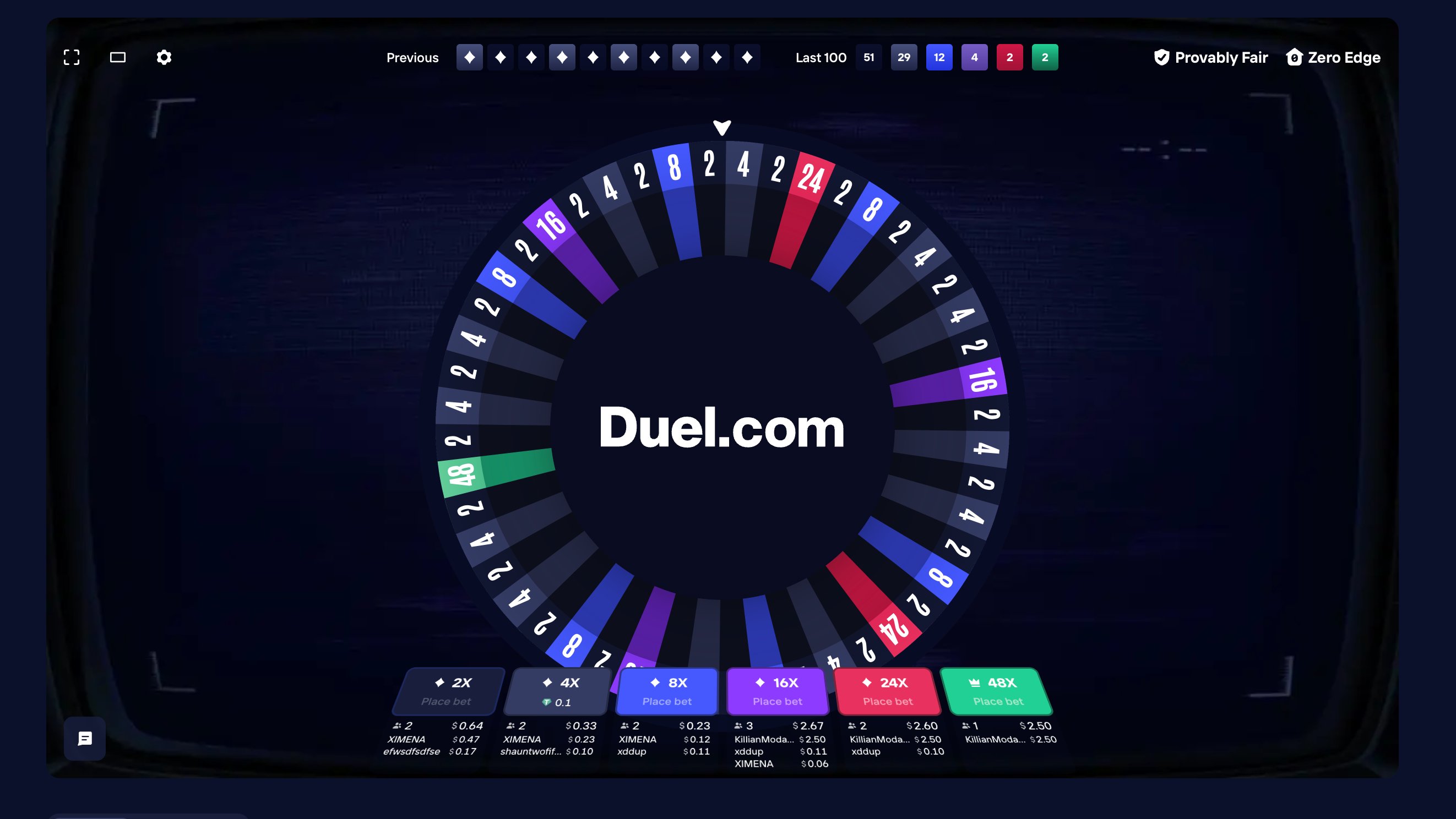
Duel.com Castle Roulette — wheel with 48 positions and 6 color tiers. Bets close before the drand beacon for the round publishes.
Once the round resolves, open the Provably Fair modal on the game page. You'll see the round ID, the hashed server seed (the casino's pre-commitment), the drand round ID used for the round, the drand randomness (now publicly available), and the revealed plaintext server seed. Castle Roulette uses drand as the per-round entropy in place of a player-controlled client seed — every player in the round verifies against the same (server seed, drand randomness) pair.
Server Seed Hashed — SHA-256 of the server seed, published before the drand beacon for the round was known.
Server Seed (revealed) — plaintext value the casino committed to. Hash it to confirm it matches the pre-commitment.
drand Round ID — the round number of the public drand beacon used as the external entropy source.
drand Randomness — the 48-byte BLS-signed randomness value published by the drand chain at the scheduled time for that round.
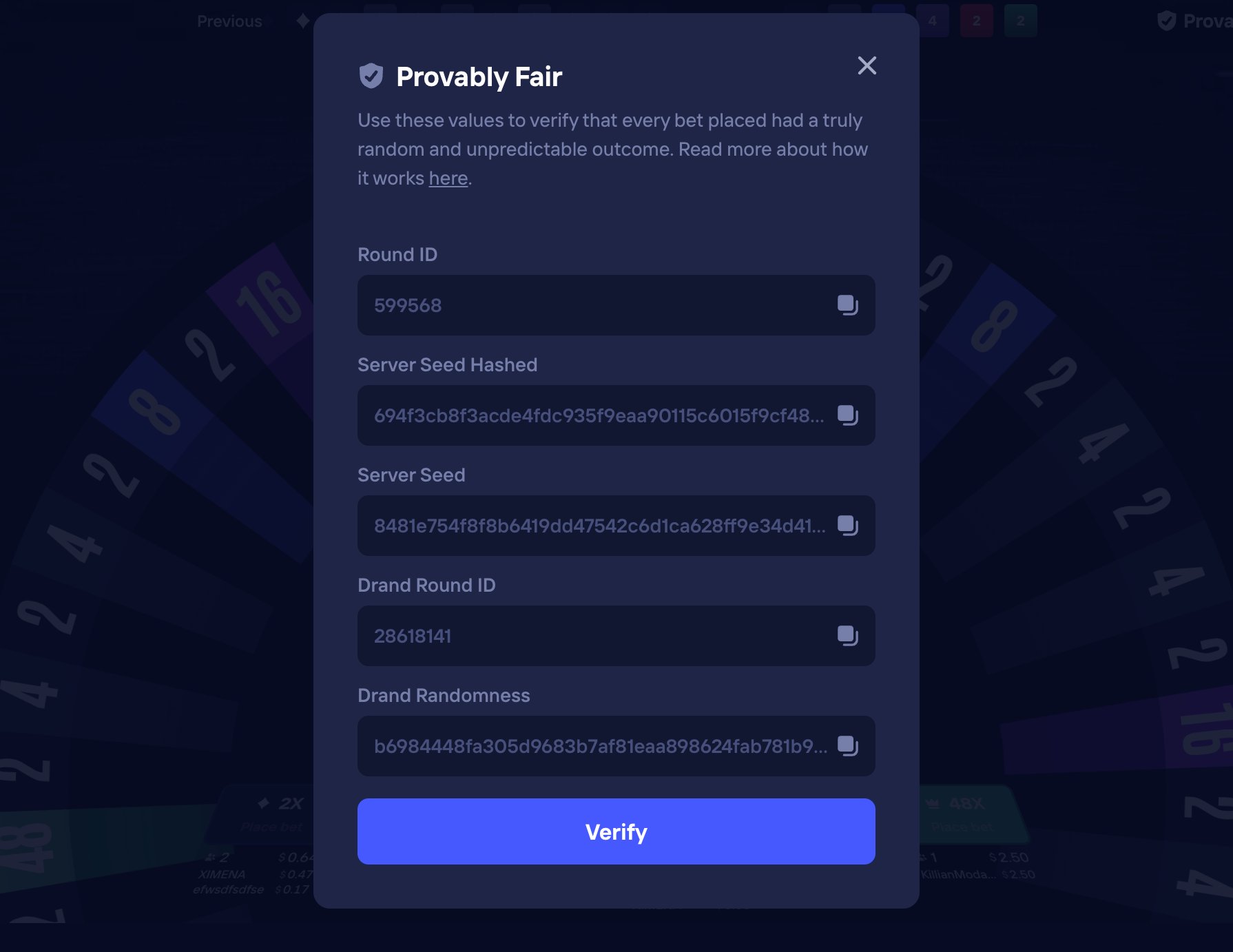
Provably Fair modal — round ID, hashed server seed, drand round ID, drand randomness, and revealed plaintext server seed.
Click Verify in the Provably Fair modal to open the Provably Fair page with the drand seed and server seed pre-populated. The page recomputes the wheel position from the disclosed inputs and renders the Game Result inline. If the recomputed wheel position matches your round's actual outcome (and the corresponding color tier matches your bet), the round was provably fair — the casino committed to its seed before the drand beacon was available, drand provided unpredictable external entropy at a schedule the casino can't influence, and the result is mathematically reproducible by anyone. The verifier also confirms the seed-hash commitment chain automatically.
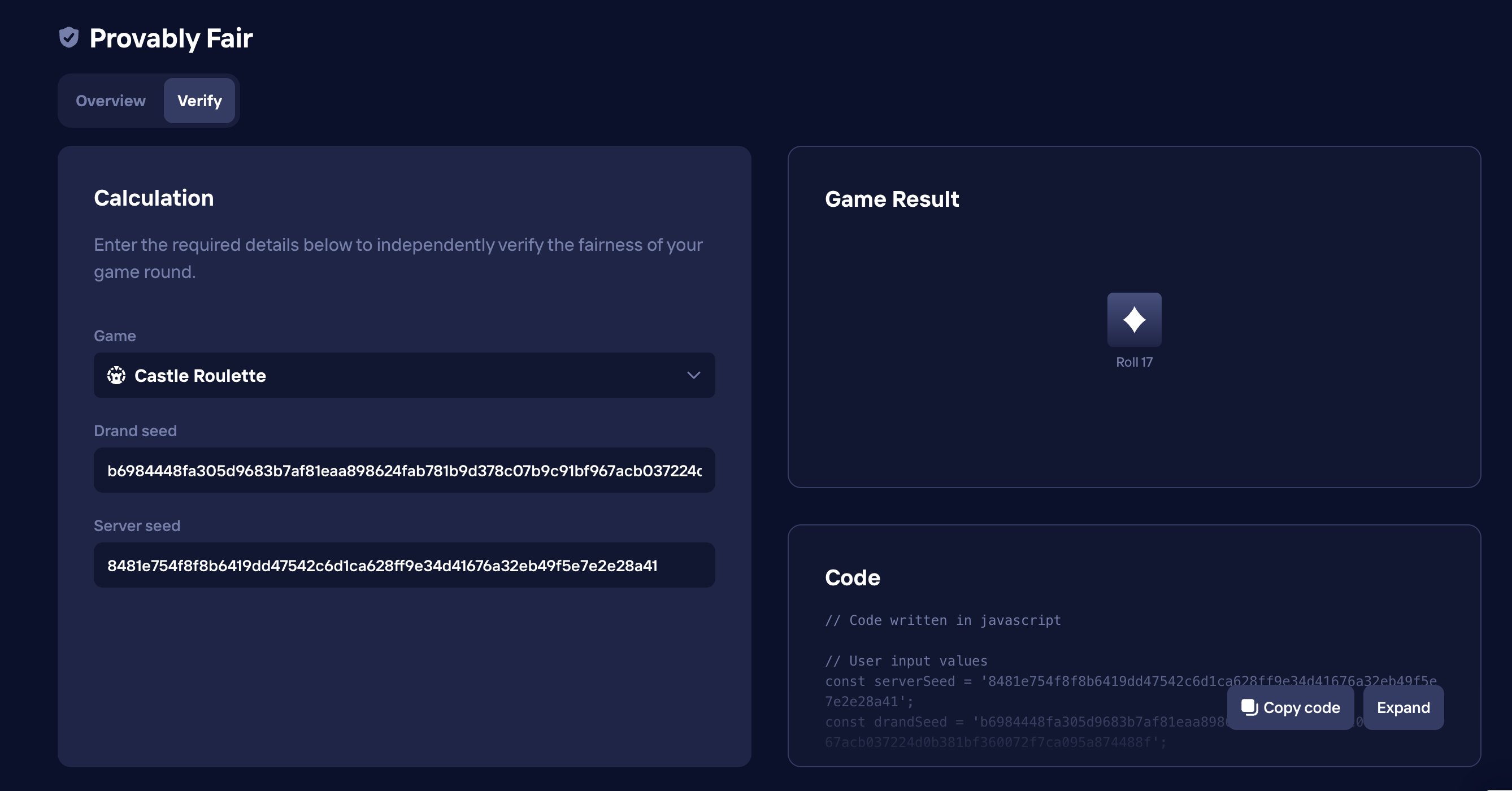
Provably Fair page — drand seed and server seed populated from the modal, recomputed wheel position rendered inline matching the live round.
The previous step proves the casino didn't change its server seed and that the inputs produce the claimed wheel position. This final step proves the drand randomness itself was real — not something the casino fabricated. Open `https://api.drand.sh/v2/beacons/quicknet/rounds/{drandRoundId}` in any browser, substituting your drand Round ID from the Provably Fair modal. The response is a tiny JSON object containing the `round` and `signature`. The `signature` value must match the drand Randomness shown in the modal exactly. drand is a public distributed beacon run by an independent network of validators; the casino has no way to influence or pre-compute these values.
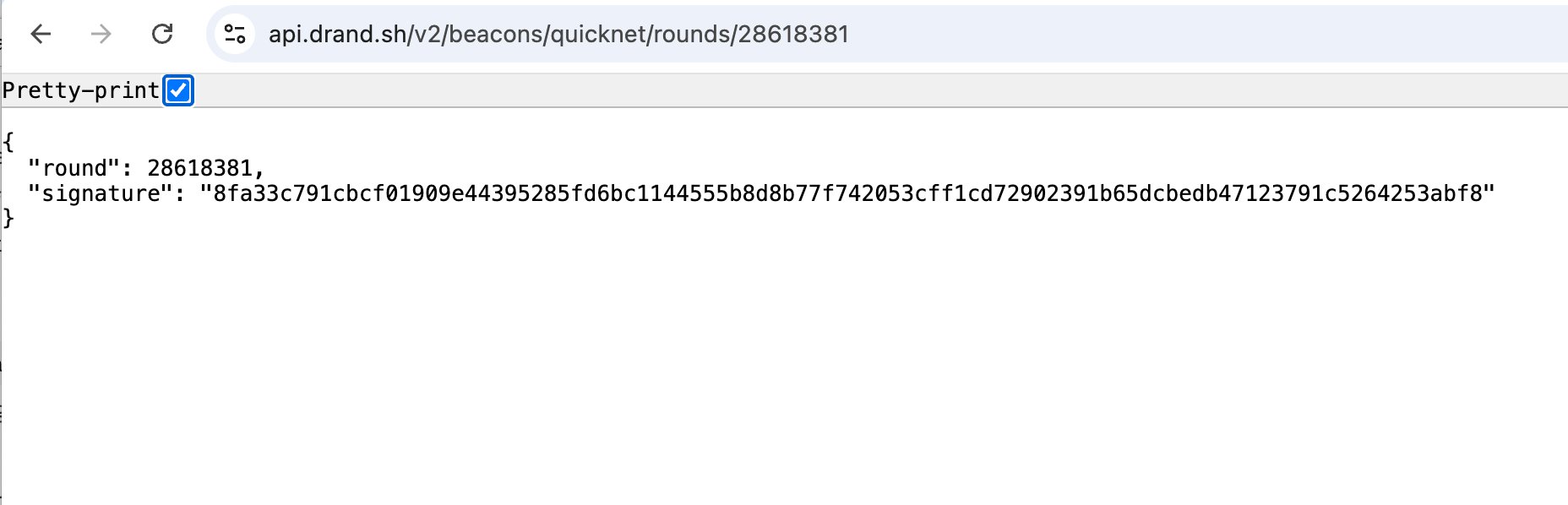
Public drand API response — round number and BLS-signed randomness fetched directly from the drand chain, independent of the casino.
Manual Verification (Advanced)6 sections
6.6Why Manual Verification Matters
True provably fair verification means you don't trust any casino-provided tool. Manual verification allows you to run calculations on your own machine, eliminate any possibility of a tampered verifier, and understand exactly how results are generated.
6.7How the Algorithm Works (Plain English)
Before each round starts, the casino locks the round's outcome using three ingredients:
- The casino's secret server seed — committed by publishing its hash before the drand beacon for the round is known
- The drand round ID — a public counter that advances every 3 seconds on the drand quicknet chain
- The drand randomness — a BLS-signed value published by drand at the scheduled time, not controllable by the casino
These three ingredients are combined with HMAC-SHA256 (a cryptographic function) to produce a single 32-byte output. The first 4 bytes are read as an unsigned integer and reduced modulo 48 (value % 48) to produce a wheel position from 0 to 47. The position is then looked up in the 6-tier PAYOUT_TABLE to determine the winning color and multiplier (Green 48× / Red 24× / Purple 16× / Blue 8× / Grey 4× / Dark Blue 2×). Because the casino committed to its seed before the drand beacon was published, and because drand is a public distributed beacon the casino cannot predict or forge, neither party can influence the outcome.
6.8Casino Verifier vs ProvablyFair.org Verifier4 records
Two verification tools are available (pending Duel.com Castle Roulette-tab confirmation). Both should produce identical results — if they don't, something has changed.
| Duel.com Verifier | ProvablyFair.org Verifier | |
|---|---|---|
| Source | Casino-controlled | Independent (audit codebase) |
| Access | duel.com/fairness/verify | audit.provablyfair.org/casino/duel/tools/verify-bets |
| Trust model | Requires trusting the casino | Open-source, version-controlled |
| Monitoring | No change detection | Mismatches detected if casino changes logic |
6.9JavaScript Verification Script
Copy and run this in Node.js to verify any Castle Roulette round:
const crypto = require('crypto'); const RANGE = 48; const PAYOUT_TABLE = (() => { const table = []; table.push({ multiplier: 48, color: 'green' }); // pos 0 for (let i = 1; i <= 2; i++) table.push({ multiplier: 24, color: 'red' }); // pos 1-2 for (let i = 3; i <= 5; i++) table.push({ multiplier: 16, color: 'purple' }); // pos 3-5 for (let i = 6; i <= 11; i++) table.push({ multiplier: 8, color: 'blue' }); // pos 6-11 for (let i = 12; i <= 23; i++) table.push({ multiplier: 4, color: 'grey' }); // pos 12-23 for (let i = 24; i <= 47; i++) table.push({ multiplier: 2, color: 'dark_blue' }); // pos 24-47 return table;})(); function computePosition(serverSeed, drandRandomness) { const keyBuffer = Buffer.from(serverSeed, 'hex'); const drandBytes = Buffer.from(drandRandomness, 'hex'); const randomness = drandBytes.toString('utf-8'); // lossy but deterministic const message = `${randomness}:0`; const hmac = crypto.createHmac('sha256', keyBuffer).update(message).digest('hex'); const value = parseInt(hmac.slice(0, 8), 16); return value % RANGE;} function verifyHash(serverSeed, serverSeedHashed) { const hash = crypto.createHash('sha256') .update(Buffer.from(serverSeed, 'hex')) .digest('hex'); return hash === serverSeedHashed;} // Replace with your round's valuesconst serverSeed = 'YOUR_SERVER_SEED';const serverSeedHashed = 'YOUR_SERVER_SEED_HASH';const drandRandomness = 'YOUR_DRAND_RANDOMNESS'; const position = computePosition(serverSeed, drandRandomness);const result = PAYOUT_TABLE[position]; console.log('Hash check: ', verifyHash(serverSeed, serverSeedHashed) ? 'PASS' : 'FAIL');console.log('Wheel position:', position);console.log('Color tier: ', result.color, `(${result.multiplier}×)`);6.10Python Verification Script
The same verification in Python (standard library only):
import hashlib, hmac RANGE = 48 PAYOUT_TABLE = ( [{'multiplier': 48, 'color': 'green'}] # pos 0 + [{'multiplier': 24, 'color': 'red'}] * 2 # pos 1-2 + [{'multiplier': 16, 'color': 'purple'}] * 3 # pos 3-5 + [{'multiplier': 8, 'color': 'blue'}] * 6 # pos 6-11 + [{'multiplier': 4, 'color': 'grey'}] * 12 # pos 12-23 + [{'multiplier': 2, 'color': 'dark_blue'}] * 24 # pos 24-47) def compute_position(server_seed, drand_randomness): key = bytes.fromhex(server_seed) drand_bytes = bytes.fromhex(drand_randomness) randomness = drand_bytes.decode('utf-8', errors='replace') # lossy but deterministic message = f'{randomness}:0'.encode('utf-8') h = hmac.new(key, message, hashlib.sha256).hexdigest() value = int(h[:8], 16) return value % RANGE def verify_hash(server_seed, server_seed_hashed): computed = hashlib.sha256(bytes.fromhex(server_seed)).hexdigest() return computed == server_seed_hashed # Replace with your round's valuesserver_seed = 'YOUR_SERVER_SEED'server_seed_hashed = 'YOUR_SERVER_SEED_HASH'drand_randomness = 'YOUR_DRAND_RANDOMNESS' position = compute_position(server_seed, drand_randomness)tier = PAYOUT_TABLE[position] print('Hash check: ', 'PASS' if verify_hash(server_seed, server_seed_hashed) else 'FAIL')print('Wheel position:', position)print('Color tier: ', tier['color'], f"({tier['multiplier']}×)")6.11Evidence Screenshots3 records
| Evidence | Description |
|---|---|
| E02 | Fairness page overview — "What is Provably Fair?" and "How it works" sections (Castle Roulette context) |
| E03 | Fairness verification tool — Castle Roulette tab selected, showing server seed hash, drand round ID, and drand randomness inputs |
| E12 | drand beacon verification — screenshot of api.drand.sh/v2/beacons/quicknet/rounds/{round} response for a captured round |
Verify a real bet, step by stepVerify a real bet · Swipe for all 4 steps →
How it works
- 1
Place a Castle Roulette Bet
Pick a color tier (Dark Blue 2×, Grey 4×, Blue 8×, Purple 16×, Red 24×, or Green 48×) and place a bet during the pre-round window. The casino has already committed to a server seed (publishing only its hash) and a drand round ID — but the drand randomness for that round hasn't been published yet, so the wheel position is locked to inputs the casino can't see or change.
- 2
Open the Fairness Modal
Once the round resolves, open the Provably Fair modal on the game page. You'll see the round ID, the hashed server seed, the drand round ID, the drand randomness (now published), and the revealed plaintext server seed.
- 3
Recompute & Confirm
Click Verify in the Provably Fair modal to open the Provably Fair page with the drand seed and server seed pre-populated. The page recomputes the wheel position inline — if it matches your round's actual position (and the corresponding color tier matches your bet), the round was provably fair.
- 4
Verify drand Independently (Optional)
Open
api.drand.sh/v2/beacons/quicknet/rounds/{drandRoundId}in any browser. Thesignaturefield must match the drand Randomness shown in the modal — proving the external entropy came from a public beacon the casino can't influence.
Visual Walkthroughstep-by-step
Pick a color tier (Dark Blue 2×, Grey 4×, Blue 8×, Purple 16×, Red 24×, or Green 48×) and place a bet during the pre-round window. The casino has already committed to a server seed (publishing only its hash) and locked in a drand round ID — but the drand randomness for that round hasn't been published yet. The wheel position is locked to inputs the casino can't see or change.
Duel.com Castle Roulette — wheel with 48 positions and 6 color tiers. Bets close before the drand beacon for the round publishes.
Once the round resolves, open the Provably Fair modal on the game page. You'll see the round ID, the hashed server seed (the casino's pre-commitment), the drand round ID used for the round, the drand randomness (now publicly available), and the revealed plaintext server seed. Castle Roulette uses drand as the per-round entropy in place of a player-controlled client seed — every player in the round verifies against the same (server seed, drand randomness) pair.
Server Seed Hashed — SHA-256 of the server seed, published before the drand beacon for the round was known.
Server Seed (revealed) — plaintext value the casino committed to. Hash it to confirm it matches the pre-commitment.
drand Round ID — the round number of the public drand beacon used as the external entropy source.
drand Randomness — the 48-byte BLS-signed randomness value published by the drand chain at the scheduled time for that round.
Provably Fair modal — round ID, hashed server seed, drand round ID, drand randomness, and revealed plaintext server seed.
Click Verify in the Provably Fair modal to open the Provably Fair page with the drand seed and server seed pre-populated. The page recomputes the wheel position from the disclosed inputs and renders the Game Result inline. If the recomputed wheel position matches your round's actual outcome (and the corresponding color tier matches your bet), the round was provably fair — the casino committed to its seed before the drand beacon was available, drand provided unpredictable external entropy at a schedule the casino can't influence, and the result is mathematically reproducible by anyone. The verifier also confirms the seed-hash commitment chain automatically.
Provably Fair page — drand seed and server seed populated from the modal, recomputed wheel position rendered inline matching the live round.
The previous step proves the casino didn't change its server seed and that the inputs produce the claimed wheel position. This final step proves the drand randomness itself was real — not something the casino fabricated. Open `https://api.drand.sh/v2/beacons/quicknet/rounds/{drandRoundId}` in any browser, substituting your drand Round ID from the Provably Fair modal. The response is a tiny JSON object containing the `round` and `signature`. The `signature` value must match the drand Randomness shown in the modal exactly. drand is a public distributed beacon run by an independent network of validators; the casino has no way to influence or pre-compute these values.
Public drand API response — round number and BLS-signed randomness fetched directly from the drand chain, independent of the casino.
Technical evidence
6.6Why Manual Verification Matters
True provably fair verification means you don't trust any casino-provided tool. Manual verification allows you to run calculations on your own machine, eliminate any possibility of a tampered verifier, and understand exactly how results are generated.
6.7How the Algorithm Works (Plain English)
Before each round starts, the casino locks the round's outcome using three ingredients:
- The casino's secret server seed — committed by publishing its hash before the drand beacon for the round is known
- The drand round ID — a public counter that advances every 3 seconds on the drand quicknet chain
- The drand randomness — a BLS-signed value published by drand at the scheduled time, not controllable by the casino
These three ingredients are combined with HMAC-SHA256 (a cryptographic function) to produce a single 32-byte output. The first 4 bytes are read as an unsigned integer and reduced modulo 48 (value % 48) to produce a wheel position from 0 to 47. The position is then looked up in the 6-tier PAYOUT_TABLE to determine the winning color and multiplier (Green 48× / Red 24× / Purple 16× / Blue 8× / Grey 4× / Dark Blue 2×). Because the casino committed to its seed before the drand beacon was published, and because drand is a public distributed beacon the casino cannot predict or forge, neither party can influence the outcome.
6.8Casino Verifier vs ProvablyFair.org Verifier4 records
Two verification tools are available (pending Duel.com Castle Roulette-tab confirmation). Both should produce identical results — if they don't, something has changed.
| Duel.com Verifier | ProvablyFair.org Verifier | |
|---|---|---|
| Source | Casino-controlled | Independent (audit codebase) |
| Access | duel.com/fairness/verify | audit.provablyfair.org/casino/duel/tools/verify-bets |
| Trust model | Requires trusting the casino | Open-source, version-controlled |
| Monitoring | No change detection | Mismatches detected if casino changes logic |
6.9JavaScript Verification Script
Copy and run this in Node.js to verify any Castle Roulette round:
const crypto = require('crypto'); const RANGE = 48; const PAYOUT_TABLE = (() => { const table = []; table.push({ multiplier: 48, color: 'green' }); // pos 0 for (let i = 1; i <= 2; i++) table.push({ multiplier: 24, color: 'red' }); // pos 1-2 for (let i = 3; i <= 5; i++) table.push({ multiplier: 16, color: 'purple' }); // pos 3-5 for (let i = 6; i <= 11; i++) table.push({ multiplier: 8, color: 'blue' }); // pos 6-11 for (let i = 12; i <= 23; i++) table.push({ multiplier: 4, color: 'grey' }); // pos 12-23 for (let i = 24; i <= 47; i++) table.push({ multiplier: 2, color: 'dark_blue' }); // pos 24-47 return table;})(); function computePosition(serverSeed, drandRandomness) { const keyBuffer = Buffer.from(serverSeed, 'hex'); const drandBytes = Buffer.from(drandRandomness, 'hex'); const randomness = drandBytes.toString('utf-8'); // lossy but deterministic const message = `${randomness}:0`; const hmac = crypto.createHmac('sha256', keyBuffer).update(message).digest('hex'); const value = parseInt(hmac.slice(0, 8), 16); return value % RANGE;} function verifyHash(serverSeed, serverSeedHashed) { const hash = crypto.createHash('sha256') .update(Buffer.from(serverSeed, 'hex')) .digest('hex'); return hash === serverSeedHashed;} // Replace with your round's valuesconst serverSeed = 'YOUR_SERVER_SEED';const serverSeedHashed = 'YOUR_SERVER_SEED_HASH';const drandRandomness = 'YOUR_DRAND_RANDOMNESS'; const position = computePosition(serverSeed, drandRandomness);const result = PAYOUT_TABLE[position]; console.log('Hash check: ', verifyHash(serverSeed, serverSeedHashed) ? 'PASS' : 'FAIL');console.log('Wheel position:', position);console.log('Color tier: ', result.color, `(${result.multiplier}×)`);6.10Python Verification Script
The same verification in Python (standard library only):
import hashlib, hmac RANGE = 48 PAYOUT_TABLE = ( [{'multiplier': 48, 'color': 'green'}] # pos 0 + [{'multiplier': 24, 'color': 'red'}] * 2 # pos 1-2 + [{'multiplier': 16, 'color': 'purple'}] * 3 # pos 3-5 + [{'multiplier': 8, 'color': 'blue'}] * 6 # pos 6-11 + [{'multiplier': 4, 'color': 'grey'}] * 12 # pos 12-23 + [{'multiplier': 2, 'color': 'dark_blue'}] * 24 # pos 24-47) def compute_position(server_seed, drand_randomness): key = bytes.fromhex(server_seed) drand_bytes = bytes.fromhex(drand_randomness) randomness = drand_bytes.decode('utf-8', errors='replace') # lossy but deterministic message = f'{randomness}:0'.encode('utf-8') h = hmac.new(key, message, hashlib.sha256).hexdigest() value = int(h[:8], 16) return value % RANGE def verify_hash(server_seed, server_seed_hashed): computed = hashlib.sha256(bytes.fromhex(server_seed)).hexdigest() return computed == server_seed_hashed # Replace with your round's valuesserver_seed = 'YOUR_SERVER_SEED'server_seed_hashed = 'YOUR_SERVER_SEED_HASH'drand_randomness = 'YOUR_DRAND_RANDOMNESS' position = compute_position(server_seed, drand_randomness)tier = PAYOUT_TABLE[position] print('Hash check: ', 'PASS' if verify_hash(server_seed, server_seed_hashed) else 'FAIL')print('Wheel position:', position)print('Color tier: ', tier['color'], f"({tier['multiplier']}×)")6.11Evidence Screenshots3 records
| Evidence | Description |
|---|---|
| E02 | Fairness page overview — "What is Provably Fair?" and "How it works" sections (Castle Roulette context) |
| E03 | Fairness verification tool — Castle Roulette tab selected, showing server seed hash, drand round ID, and drand randomness inputs |
| E12 | drand beacon verification — screenshot of api.drand.sh/v2/beacons/quicknet/rounds/{round} response for a captured round |
Only disclosed inputs are used. Identical inputs always produce identical wheel positions. The external entropy (drand) is independently verifiable against a public chain.
Reproducibility & Artifacts
Can anyone independently reproduce every finding in this audit?
This section consolidates the open-source repository, datasets, output artifacts, and reproducibility posture of the audit. Every finding, every statistic, every pass/fail result can be independently reproduced by anyone with a computer and an internet connection. The repository is the credential — not this report.

Open-Source Audit Repository
Repository Details
- GitHub: ProvablyFair-org/duel-castle-roulette
- Commit: e57da3e
- Game: Castle Roulette (duel-castle-roulette)
- Public Verifier: audit.provablyfair.org/casino/duel/tools/verify-bets
Prerequisites
- Node.js 18+
- npm 8+
- Git
- TypeScript (installed via npm)
- GitHub: ProvablyFair-org/duel-castle-roulette
- Commit: e57da3e
- Game: Castle Roulette (duel-castle-roulette)
- Public Verifier: audit.provablyfair.org/casino/duel/tools/verify-bets
- Node.js 18+
- npm 8+
- Git
- TypeScript (installed via npm)
All audit results can be independently reproduced using the pinned commit, dataset, and commands above. The dataset hash ensures you're running against the same 1,350 rounds.

Commands to Reproduce
Installs TypeScript, ts-node, and cryptographic dependencies. npm test runs mocha (20 unit tests), then the 5M-round simulation, then the 16-step verification pipeline.
git clone https://github.com/ProvablyFair-org/duel-castle-roulette.gitcd duel-castle-roulettenpm install # Run entire audit end-to-end (20 unit tests + simulation + verification)npm testnpx ts-node tests/verify.ts[PASS] Step 1 — Seed Hash Integrity[PASS] Step 2 — drand Commitment Timing (Pre-Commitment)[PASS] Step 3 — drand Round Monotonicity[PASS] Step 4 — Server Seed Uniqueness[PASS] Step 5 — Position Recomputation[PASS] Step 6 — Bet-Size Invariance[PASS] Step 7 — Payout Math[PASS] Step 8 — Color-Position Mapping[PASS] Step 9 — Captured effectiveEdge Field Consistency[PASS] Step 10 — Phase Coverage[PASS] Step 11 — Dataset Hash[PASS] Step 12 — drand Chain Formula[PASS] Step 13 — Anti-Circularity (Zero Edge by Construction)[PASS] Step 14 — Simulation Pass 1 (Fisher's Combined — 10 Streams)[PASS] Step 15 — Simulation Pass 2 (Casino Seeds)[PASS] Step 16 — drand API Signature Verification 16 passing, 0 flags, 0 hard failuresSimulates 10 independent streams × 500,000 rounds each (5M total). Runtime ~8 minutes. Output written to outputs/simulation-results.json and outputs/rtp-convergence.html.
npx ts-node src/simulate.tsAudit Reproducibility Pinning
- Git Commit
- e57da3e96211d6e9fd404f44e497ceac0b59e55d
- Node Version
- v18+ (tested on v22.x)
- Dataset
- data/castle-roulette-master-1350rounds.json (1,350 rounds, 5 phases)
- Dataset Hash (SHA-256)
- 506e05ee9c07966a…1ffd66ce
- Audit Date
- April 2026
- Audit ID
- PF-2026-DL07
Output Artifacts4 files generated
| File | Contents | Size |
|---|---|---|
| verification-results.json | Steps 1–16 results, per-step pass/fail with evidence | ~5KB |
| simulation-results.json | 5M-round RTP, Fisher's combined, cherry-pick detection (Pass 1 + Pass 2) | ~3KB |
| drand-api-verification.json | 1,350 drand signature comparisons vs api.drand.sh (pinned artifact for Step 16) | ~470KB |
| rtp-convergence.html | Interactive per-stream RTP convergence chart (self-contained HTML) | ~4KB |
Repository Structure
duel-castle-roulette/
├── src/
│   ├── rng.ts                  → HMAC-SHA256 + value % 48 mapping + 6-tier PAYOUT_TABLE
│   ├── simulate.ts             → Monte Carlo — 5M rounds (10 streams × 500K)
│   ├── stats.ts                → Chi-squared, Fisher's combined, autocorrelation, runs test
│   ├── loader.ts               → Dataset loader + SHA-256 hash guard
│   ├── types.ts                → Type definitions
│   └── verify-drand-timing.js  → drand API signature re-fetch (pinned artifact)
├── tests/
│   ├── verify.ts               → 16-step verification pipeline
│   ├── steps/
│   │   ├── commitment.ts       → Steps 1–4: Seed hash, timing, drand monotonicity, seed uniqueness
│   │   ├── determinism.ts      → Steps 5–6: Position recomputation + bet-size invariance
│   │   ├── payouts.ts          → Steps 7–10: Payout math + isWin + color-position + zero edge + phase coverage
│   │   ├── dataset.ts          → Steps 11–13: Dataset hash + drand chain formula + anti-circularity
│   │   ├── simulation.ts       → Steps 14–16: Simulation Pass 1/2 + drand API auth
│   │   ├── statistical.ts      → Informational: Live per-tier RTP + phase summaries
│   │   └── context.ts          → Shared context + pass/fail helpers
│   └── castle-roulette/
│       └── CastleRouletteTests.ts → 20 unit tests (Mocha)
├── data/
│   └── castle-roulette-master-1350rounds.json → 1,350 live rounds (5 phases)
├── outputs/                    → Generated by npm test
│   ├── verification-results.json → Steps 1–16 pass/fail
│   ├── simulation-results.json   → 5M rounds, per-stream RTP, Fisher's combined, cherry-pick
│   ├── drand-api-verification.json → 1,350 drand signature comparisons vs api.drand.sh
│   └── rtp-convergence.html      → Interactive per-stream RTP convergence chart
├── results/                 → Reserved for run artifacts (.gitkeep)
├── evidence/
│   └── E01–E04 *.png           → Game UI, fairness page, verify page, provably fair panel
├── capture/
│   └── castle-roulette-capture.reference.js → Browser round capture script
├── package.json
├── package-lock.json
├── tsconfig.json
├── .mocharc.yml
├── .gitignore
├── MANIFEST.md             → Audit ID, scope, reproduction steps
└── README.md               → Repo overview + offline npm test instructions
Step-to-Section Cross-Reference16 verification steps mapped
| Step | Test Name | Report Section |
|---|---|---|
| 1 | Seed Hash Integrity | S1, S5 |
| 2 | drand Commitment Timing (Pre-Commitment) | S1, S5 |
| 3 | drand Round Monotonicity | S1, S5 |
| 4 | Server Seed Uniqueness | S1, S5 |
| 5 | Position Recomputation | S1, S2, S3, S5 |
| 6 | Bet-Size Invariance | S3, S4, S5 |
| 7 | Payout Math (amountWon + isWin) | S3 |
| 8 | Color-Position Mapping | S3 |
| 9 | Captured effectiveEdge Field Consistency | S3, S4, S5 |
| 10 | Phase Coverage | S7 |
| 11 | Dataset Hash | S7 |
| 12 | drand Chain Formula | S1 |
| 13 | Anti-Circularity (Zero Edge by Construction) | S4, S5 |
| 14 | Simulation Pass 1 (Fisher's Combined — 10 Streams) | S2, S4, S5 |
| 15 | Simulation Pass 2 (Casino Seeds) | S2, S4, S5 |
| 16 | drand API Signature Verification | S2, S5 |
reproduce-audit.sh
# Clone and setupgit clone https://github.com/ProvablyFair-org/duel-castle-roulette.gitcd duel-castle-roulettegit checkout [COMMIT_HASH]npm install # Run full audit (5M simulation + 16 verification steps; offline by default)npm test # Or run individual componentsnpm run simulate # 5M-round multi-stream simulation (10 streams × 500K)npm run verify # 16-step verification pipeline (reads pinned artifacts — no network)npm run timing # optional: re-fetch all 1,350 drand signatures from api.drand.sh # (regenerates outputs/drand-api-verification.json — requires internet) # View generated reportscat outputs/verification-results.jsoncat outputs/simulation-results.jsoncat outputs/drand-api-verification.jsonAll audit results can be independently reproduced using the pinned commit, dataset, and commands above. The dataset hash ensures you're running against the same 1,350 rounds.